
Federal grant dollars provide critical public services for everyday Ohioans
The Trump administration announced on Jan. 27, 2025, that it would temporarily pause federal grant, loan, and other financial assistance programs. This would have enormous ripple effects in Ohio and elsewhere. A federal judge the following day temporarily blocked the policy, averting what would have been a devastating freeze of federal dollars. As of publication, the administration has rescinded the memo announcing the freeze. The lawsuits, however, continue — as does the administration’s directive that agencies review spending in consideration of the ideological prerogatives of the President’s executive orders.
Below is an overview of how Ohio relies on federal grant dollars for programs and services that impact millions of Ohioans. See this spreadsheet for details.
Ohio in 2024 received about $41.3 billion in federal grants that supported programs and services, including childcare, transportation, infrastructure repairs, worker training, housing, food security, health care, and much more.
Ohio received more federal dollars than what taxpayers sent to the federal government.
- For context, even excluding COVID dollars, federal funding to Ohio in 2022 was $13,986 per person, according to the Rockefeller Institute of Government. The majority of federal money is returned to Ohio as direct payments to individuals.
- During this same year, Ohioans sent on average $10,865 per person to the federal government through their taxes.
- This means for every $1 Ohio sent to the federal government, the state received $1.29 back for shared programs and services.
- Ohio’s net return for federal dollars in 2022, was about $36.7 billion, excluding COVID funds, which was the nation’s 7th highest.
Many of the same programs that were targeted by the freeze are being considered for cuts by congress in the looming federal budget debate. Certainly, there will be pressure from the White House to make drastic changes in the kinds of programs people rely on: Medicaid, Social Security, Food Assistance, and more.
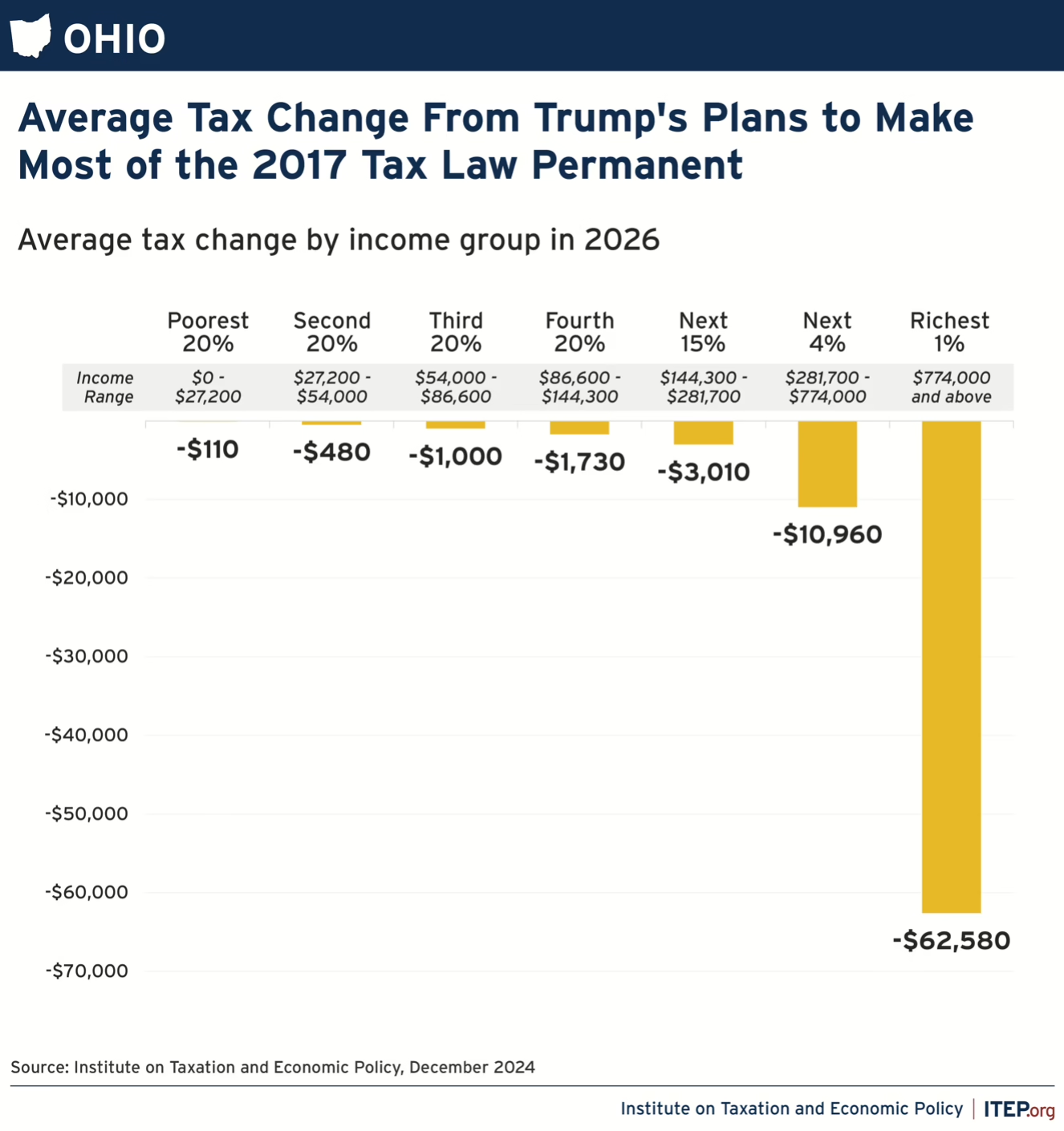
Major cuts will be necessary to pay for the continuation of Trump’s tax cuts, which have overwhelmingly benefited the very richest among us and large corporations. The Institution on Taxation and Economic Policy (ITEP) modeled how expanding the 2017 tax cuts would impact Ohioans. They found that the top 1%, who make $774,000 or more annually, would on average receive a tax cut of more than $62,000, while the rest of us stand to lose out on the public services funded by tax dollars.
We encourage all Ohioans who have questions to contact their U.S. Senators Bernie Moreno and John Husted; their U.S. Representative; and Gov. Mike DeWine, all of whom should be advocating for Ohioans every single day.
Among the most pressing questions for these leaders:
- How will you protect Ohioans from future budget cuts — particularly cuts to Medicaid, Medicare, Food Assistance, Social Security and other programs providing direct payments to Ohioans?
- How many Ohioans are being affected by the continuing review? How many could be harmed by cuts resulting from the review?
- Who determines whether a federal program or grant doesn’t comply with the President’s executive orders and ideological tests? How do they make that determination?
- Will people and states receive notice of such additional freezes or changes in federal funding?
- What will you do if this happens again?
Lame duck is an opportunity for legislators to act on data centers (and more)