
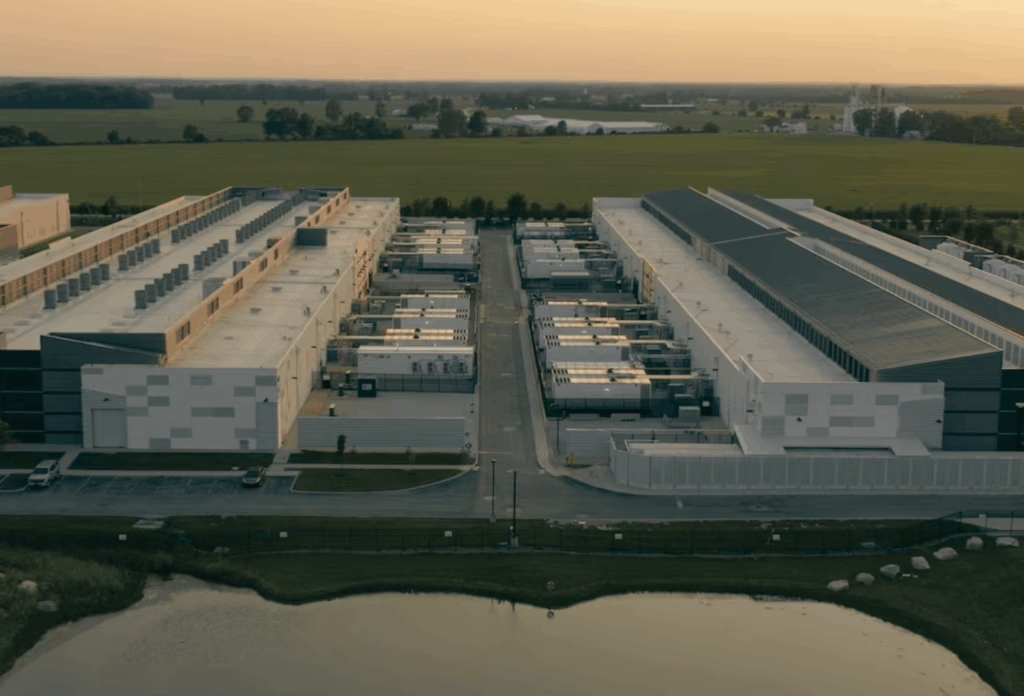
Ohio’s legislature has given generous incentives to tech companies to build data centers in our state.
Ohioans should have a say in whether and how to allow these facilities in our communities.
Data centers are large facilities filled with servers that store, process, and transmit digital information. They are critical for artificial intelligence, cloud storage, streaming videos, financial systems, and more. Running thousands of servers 24/7 requires huge amounts of electricity, and regulating their temperature requires huge amounts of water. The AI boom has driven rapid expansion of new data centers across the country. Ohio is among the states with the most existing and planned data centers.
Hyperscale data centers are massive facilities that consume far more electricity than earlier generations of data centers. Their size and energy demands are driven by the rapid expansion of Artificial Intelligence. Hyperscale facilities are typically defined as having a minimum capacity of 40 MW or 50 MW. Learn more about hyperscalers here.
Many Ohioans have expressed growing concerns about the rapid expansion of data center projects and their implications for energy affordability, fossil fuel reliance, air and noise pollution, water consumption and wastewater discharge, and land use.
Data centers’ economic and environmental impacts are not fully understood yet, and the pace of their expansion often prevents local communities from providing the critical input that would inform responsible data center development.
While policymakers leave many Ohioans out of the process, they give special treatment to data centers. The state places strict rules on renewable energy projects – many of which could have moderated rising energy costs but have been blocked by local opposition – but gives generous tax breaks to data centers, costing Ohio more than $135 million in lost tax revenue in 2025 and even more in the years ahead.
The economic benefits of these subsidies are minimal, and though new data centers create important job opportunities for laborers and electricians during the construction phase, some deals amount to extremely high public costs per job once facilities are in operation.
Data center construction projects generate substantial work for skilled tradespeople, like construction and electrical workers, which opens pathways to good union jobs. Project Labor Agreements (PLAs) can ensure data center companies use union labor and invest in apprenticeship training opportunities to connect workers to jobs in the trades with good wages, benefits, and strong worker protections.
Once they are up and running, data centers directly employ a relatively small number of workers to carry out their core operations. For example, in 2024, Gov. DeWine announced nearly $1.1 billion in private investment coming to the state, creating 415 new jobs. New Microsoft data center facilities represented 90.9% of that investment but only 4.8% of new full-time-equivalent jobs created.
Communities can partner with labor to secure long-term commitments to strong labor standards for direct and indirect jobs involved in data center operations and maintenance by negotiating a Community Benefit Agreement (CBA) or by including provisions for good job standards in other development agreements.
Data centers raise the cost of electricity for everyday Ohioans because they require so much of it, and Ohio’s aging infrastructure isn’t able to keep pace with their rapid expansion. The spread of data centers is the primary driver of growing electricity demand in the state. Ohio already uses more electricity than we generate; building more data centers increases the risk of disrupting services throughout the state.
PJM Interconnection is responsible for managing and operating the regional transmission grid that spans Ohio and all or part of 12 other states, transporting large, high-voltage volumes of electricity from power plants to local distribution networks. PJM holds regular capacity auctions to ensure electric distribution utilities (like AEP or the Illuminating Company) have enough generation capacity to meet peak demand and prevent service disruptions. Because demand is rising much faster than supply – driven heavily by new data centers – recent auctions have seen historic spikes in capacity prices, reflected in household electricity bills.
*In July 2026, PJM announced even greater rate increases — $6.3B across its service area in the next three years. Read our response.
Moreover, utility companies are scrambling to keep up with data centers’ demands, investing heavily in grid improvements and new or upgraded transmission infrastructure. Since the costs of utilities’ transmission spending are borne by residential and industrial customers alike, lawmakers should create policy to ensure these costs aren’t passed on to Ohio families and other everyday ratepayers.
State and local legislators are responsible for making policy to ensure data center development benefits Ohio’s workforce and does not come at the expense of Ohio families, our grid stability, public resources, or environmental health. They are responsible for regulating data center development across the state, mitigating harms, and ensuring Ohioans have the power to determine what the data center landscape looks in their communities.
Behind the meter (BTM) refers to energy generated on the customer’s side of the electric meter. BTM requirements (sometimes called “Bring Your Own Energy” or BYOE policies) can ensure data centers generate their own power, rather than drawing from the utilities that serve everyday consumers and smaller energy users.
On the surface, it seems like a good way to keep them from driving up costs for ratepayers and straining the electric grid, but BTM requirements have significant downsides — which legislators could mitigate, with the right policies.
Ohio legislators have recently reduced regulations on new electricity-generating facilities — largely in response to increased demand from data centers. As a result, data center companies can now build their own BTM projects more quickly and with less oversight.
Data center companies’ preferred BTM projects are the kinds that should be strictly regulated. Natural gas and nuclear plants — which currently are the only options that can generate enough electricity with the round-the-clock consistency required by data centers — are instead being fast-tracked. This has led to approval for natural gas power plants bordering residential and commercial areas, often without requirements for public information meetings or public hearings. A number of SMRs — small nuclear reactors —have also been proposed (though not yet approved), including several in rural southern Ohio communities.
Companies may also receive property-tax breaks for energy-generation assets, allowing them to avoid even more in taxes than they already do, without addressing the energy affordability crisis Ohio ratepayers face.
Read our brief, Behind-the-Meter is no solution for data center energy demands.
Absolutely! Lawmakers should:
Potentially: Wisconsin is considering a bill that would create a new, “very large” customer class, establish large energy customer fees, set renewable requirements (at 70%), and allow utilities to create a renewable resource tariff for industrial and commercial users. It also includes provisions for water usage, reporting, and prevailing wage requirements on data center construction projects.