
Correction: October 20, 2025 | This release has been corrected: Just 12% of Americans believe wealthy families pay too much in taxes, according to this poll. The correction appears in bold; incorrectly reported data is struck through.
The state legislature delivered Ohio millionaires one of the biggest income tax cuts in the nation this year, according to a new analysis from the Institute on Taxation and Economic Policy (ITEP).
The plan to flatten Ohio’s income tax rate to 2.75% by 2026 will provide the average millionaire in Ohio $19,000 in annual cuts — more than 100 times the average tax reduction for non-millionaires. Ohioans earning less than $26,050 don’t benefit from the cut at all.
“Under the flat tax, millionaires will soon pay the same rate as teachers,” said Policy Matters Tax Researcher Aditi Srivastava. “It’s deeply unjust—especially as Ohio underfunds our schools and refuses to finance help for people struggling with unaffordable property tax bills.”
After a one-year phase in, during which the tax rate on incomes over $100,000 drops from 3.5% to 3.125%, the flat tax is estimated to cost the state more than $1 billion in annual lost revenue, including $350 million a year in cuts for millionaires.
Just 12 17 percent of Americans believe wealthy families are overtaxed, yet Ohio lawmakers are advancing tax policies that overwhelmingly benefit the richest residents. At the federal level, the new Trump tax law is projected to deliver $1 trillion in tax cuts to the highest-income 1% nationwide over the next decade – including an average of $61,340 to Ohio’s top 1% in 2026 alone. Ohio lawmakers have chosen to compound those benefits by cutting state income taxes to disproportionately benefit Ohio’s wealthiest residents.
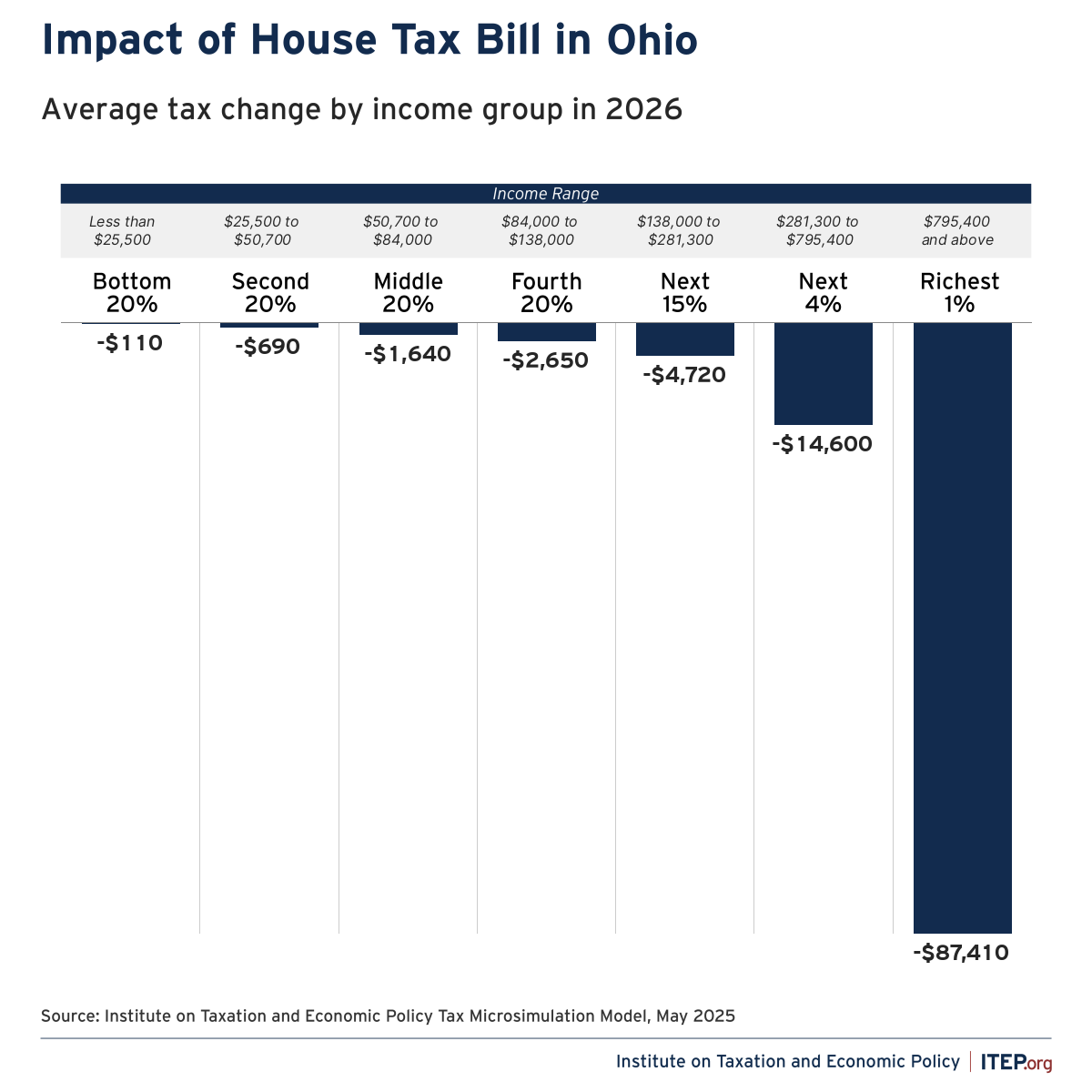
“These tax cuts are not only fiscally reckless but also deeply inequitable,” said Aidan Davis, ITEP’s State Policy Director. “It’s indefensible to hand millionaires five- and six-figure annual tax cuts while so many families struggle to afford the basics.”
The ITEP report examines five states – including Ohio – that enacted tax cuts for millionaires in 2025. Together, these cuts will reduce state revenues by more than $800 million in 2026 and an estimated $2.2 billion a year across the five states once fully implemented. (The other four states are Kansas, Mississippi, Missouri, and Oklahoma.)
“These policies double down on inequality,” said Dylan Grundman O’Neill, ITEP Senior Analyst. “They prioritize millionaires while putting critical services like education, health care, and infrastructure at risk for everyone else.”
Lame duck is an opportunity for legislators to act on data centers (and more)