
Testimony to the House Ways and Means Committee on H.B. 96
Good morning, Chair Roemer, Vice-Chair Thomas, Ranking Member Troy, members of the House Ways and Means Committee. My name is Bailey Williams, and I am a tax policy researcher at Policy Matters Ohio, a nonprofit, nonpartisan research organization with the mission of creating a more vibrant, equitable, sustainable, and inclusive Ohio. Thank you for the opportunity to testify on HB 96, the governor’s proposed state operating budget for Fiscal Years 2026 and 2027.
No income-tax cuts
There are a few good tax elements included in the Governor’s Budget, but the most notable is what was not included: Further changes to the state’s income tax. Comments from Gov. DeWine and from OBM Director Murnieks convey their reasoning on this, summed as “we’ve cut it enough, we’re competitive enough.” I’d like to start by reiterating this point. No cuts to our personal income tax are necessary to be competitive compared to surrounding states. Any additional cuts would be fiscally irresponsible and further tilt our tax system in favor of the wealthiest Ohioans. This includes a push to flatten our income tax.
Ohio’s overall tax structure in general and taxes on businesses in particular are lower than the national average.[1] A number of our neighboring states have flat income taxes with rates higher than our top marginal rate of 3.5%, while some are below. Illinois, Kentucky, and Michigan have higher rates of 4.95%, 4.0%, and 4.25% respectively. Pennsylvania and Indiana have lower rates at 3.07% and 3.0%, respectively. To reiterate Gov. DeWine’s comments at his budget press conference, not one company has told the governor our state income taxes hinder their business from coming to Ohio.
What will hinder Ohio’s growth is further income tax cuts when the state is struggling to constitutionally fund our public schools or enact targeted tax relief in the form of tax credits. If anything, Ohio needs to reverse course on a generation of income tax cuts that has left the state with an annual revenue shortfall of nearly $13 billion.[2] Policy Matters Ohio’s proactive revenue plan would ask the wealthiest 3.1% to pay their fair share in the form of an additional 2% of their income to equitably and sustainability fund our schools, parks, and other services, as well as tax credits for low- and moderate-income Ohioans.[3] This plan gives the state the opportunity to build on ideas such as Gov. DeWine’s proposed child tax credit.
Child tax credit
The main tax provision of Gov. DeWine’s budget is a first-of-its-kind child tax credit. Several advocates are here today to testify to its qualities. A fully refundable tax credit valued at up to $1,000 for a child under the age of 7 will put money directly into the pockets of parents who need it. The credit also has a phase-out feature as household income increases. This prevents what is known as a benefits cliff, where benefits drop off due to increased income, leaving one in a worse economic position. It also keeps the cost of the credit low by targeting it to those with greater need. While Policy Matters supports this proposal and sees real strengths in this credit, compared to others across the country, we can do even better.
The main weakness in the governor’s tax credit is the earnings requirement. To begin qualifying for at least a partial credit, a potential claimant must have at least $2,500 in income. This earning requirement undercuts the governor’s claim the credit is targeted for those with the most need. If that were truly the case, there would be no earnings requirement or a phase-in. Parents with zero income, by definition those with the greatest need, would qualify for the full value of the credit. According to the Center on Budget and Policy Priorities, of the 14 other states and Washington, D.C. with a child tax credit, none of them have an earnings requirement.[4] Ohio should join these states by creating a child tax credit with no earnings requirement. Additionally, to aid parents with children of all ages, Policy Matters recommends covering kids through the age of 17 with a credit of $500. When the opportunity comes to assist working parents in Ohio, we should go all in. These improvements to the proposed child tax credit would do just that.
Tobacco tax changes
You also have the opportunity to improve the governor’s method for raising revenue. The main revenue-raising change in HB 96 is an increase to tobacco taxes. In addition to parity changes across tobacco products, the crux of the proposal would nearly double the current rate on a pack of cigarettes. HB 96 would increase the current $1.60-a-pack rate to $3.10 a pack. This would place Ohio in the top ten states with the highest excise tax on tobacco, just below Hawaii at $3.20 a pack.[5] The governor’s proposal is projected to raise an additional $434 million in Fiscal Year 2026 and $463 million in Fiscal Year 2027 in additional revenue. We have concerns about the revenue’s reliability as well as who is most likely to bear this tax increase.
The tobacco tax is simply not a reliable source of revenue. The $750 million in revenue it raised in Fiscal Year 2024 is roughly a 25% drop from fiscal year 2016, the last year the tax was increased, when it brought in just over $1 billion.[6] Of course, this decrease only represents the decline in nominal terms and does not account for inflation. Had the tobacco tax revenue kept up with the 32.4% cumulative rate of inflation since 2016, the tax would have raised $1.32 billion in Fiscal Year 2024. Instead, the $750 million it did raise represents a 44% decline in the purchasing power of this revenue over that period. As smoking becomes less and less prevalent, the revenue from taxing tobacco becomes less and less dependable. This issue is bigger than one of an inadequate revenue source. It is also an inequitable revenue source.
As with almost any excise taxes, an increase to the cigarette tax is going to be highly regressive. This means the cost of the tax will fall hardest on those with the lowest incomes, consuming a higher share of their income compared to their wealthy counterparts. This is particularly true of cigarette taxes. Below is a table modeling the distribution impact of the two cigarette tax increases Ohio has enacted since 2005. This modeling was conducted by the Institute on Taxation and Economic Policy (ITEP), a national nonprofit research institute with a sophisticated model of the state and local tax system. The results show most of the revenue generated from this tax increase is coming from the lowest earning Ohioans. Nearly 50% of the tax revenue raised is being paid by individuals making less than $47,000 a year.
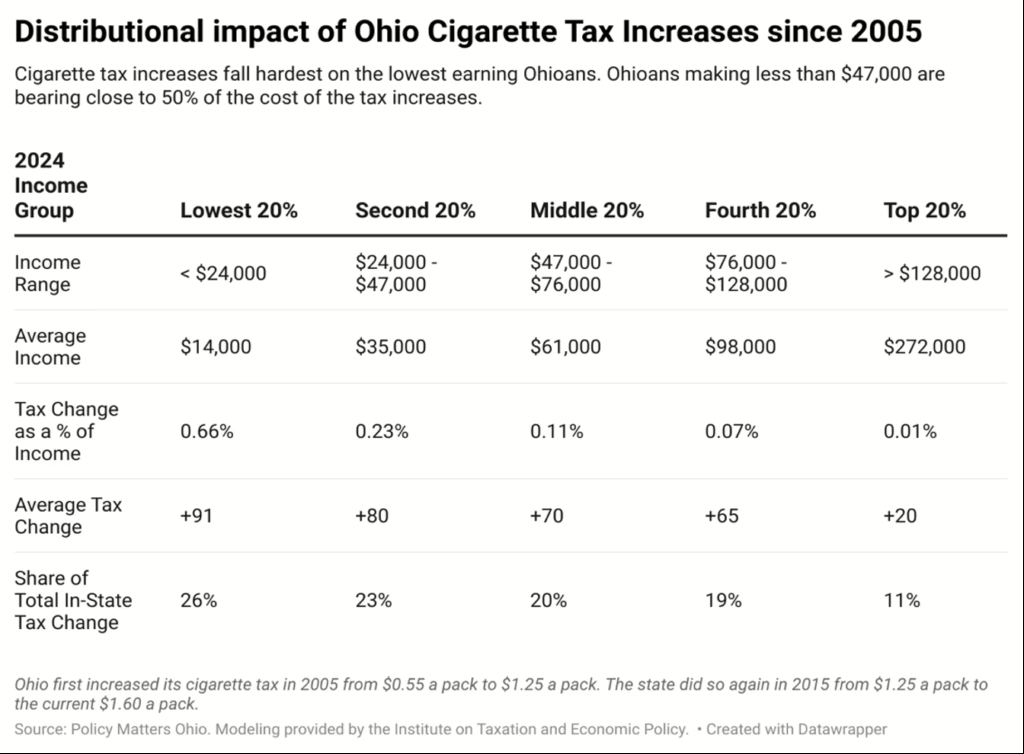
Our tax system is already upside-down, with the top 1% paying half the share of income to state and local taxes as the lowest 20% of earners.[7] While there is a good rationale for raising tobacco taxes as a public health measure, to curb smoking, making that the sole revenue source for this needed new tax credit is unwise. Instead, we urge you to cut unneeded tax breaks like the business income deduction and the sales-tax exemption for data centers.
Cannabis changes
HB 96 also includes several changes to the state’s cannabis laws. These tax rates and revenue streams were established by passage of an initiated statute known as Issue 2 and approved by over two million Ohioans in 2023. The proposed budget eliminates all revenue streams and tax rates passed by Issue 2, replacing them with an increased excise tax on recreational marijuana sales from 10% to 20%. The proposal would deposit the revenue in a new fund for non-medical marijuana tax revenue (QG18). The fund supports a variety of programs and line items across six different agencies: Health, Commerce, the Attorney General’s office, Public Safety, Behavioral Health, and Tax.[8] These proposed changes are a slap in the face to the Ohioans who supported the revenue streams currently in effect, designed to benefit local communities and mitigate the harm done by the War on Drugs.
The lion’s share of the revenue from the current 10% excise tax on cannabis sales is dedicated to two funds: The host community cannabis fund and the cannabis social equity and jobs fund. The first fund is for municipalities that have dispensaries in their cities. This ensures the localities that welcome these dispensaries within their jurisdiction benefit from the revenue generated locally. HB 96 proposes eliminating this stream and putting revenue in the GRF. This directly robs localities of revenue they could use to safely regulate the market in their communities.
The second, the cannabis social equity and jobs fund, is designed to repair some of the destruction caused by the War on Drugs. The War on Drugs devastated communities, particularly communities of color, through over-policing, criminal sentencing inequities, and the downstream economic consequences of both. The cannabis social equity and jobs fund, while yet to be operational, was created to address some of these harms from criminalizing this industry by giving opportunities to those who were likely on the receiving end of the criminalization. This budget does not simply eliminate those opportunities by eliminating the fund, it doubles down on the same failed polices of the War on Drugs by funneling revenue into policing and jail construction. This is an absolutely disgraceful use of this revenue. Strip this provision from HB 96 and keep the cannabis revenue where it is.
Sports gaming changes
The final major tax change in HB 96 is the increase to the sports gaming tax. The proposal would double the current rate of 20% to 40% of earnings from bets placed. This would be the second time the rate was doubled in two years, after the previous budget bill increased the rate from 10% to 20%. A 40% rate would make us the state with the fourth-highest tax for sports gaming, just ahead of Pennsylvania’s 36% rate. The problem has less to do with the rate increase than with the change in what this revenue will fund.
HB 96 proposes a change in the current revenue distribution for sporting gaming tax revenue. Currently, the tax revenue goes to funding extra-curricular activities in schools across the state. The governor’s budget proposes using the projected extra $150 million a year the tax would raise to establish a fund for professional sports teams to tap into for facility and stadium improvements. At a time when we are struggling to fund the basics for our schools, the governor proposes one fund meant solely for our students be shared with billionaire sports teams owners playing brinkmanship for their next taxpayer-funded bailout. These tax dollars must stay with the next generation of Ohioans, not today’s billionaires.
Conclusion
In summation, the governor’s budget includes a few good proposals on tax policy, but the fact is we can do much better. We support measures to prevent youth from easily accessing harmful drugs and the establishment of a child tax credit, but we mustn’t stop there. I urge this committee to pass an operating budget that raises the revenue we need by asking the wealthy to pay their fair share to fund the public services and goods we need. Thank you and I welcome the opportunity to answer any questions.
[1] Total State and Local Business Taxes. Council on State Taxation. December 2024.
[2] Bailey Williams, The Great Ohio Tax Shift, Policy Matters Ohio. September 26, 2024.
[3] Bailey Williams, Revise Ohio’s Tax Code to Benefit Everyday Ohioans. February 14, 2025.
[4] Samantha Waxman, Joanna Lefebvre, Sonali Master. State Should Continue Enacting and Expanding Child Tax Credits and Earned Income Tax Credits. Center on Budget and Policy Priorities. August 26, 2024.
[5] State Tobacco Activities Tracking and Evaluation System. Center on Disease Control and Prevention. September 27, 2024.
[6] Selected Ohio Tax Sources Administered by the Tax Commissioner: Net Tax Collections (a), Fiscal Years 1974-2024. Ohio Department of Taxation. January 28, 2025.
[7] Who Pays? 7th Edition. Institute on Taxation and Economic Policy. January 2024.
[8] Kathryn Poe, Bailey Williams, DeWine proposes changes to cannabis tax policy. Policy Matters Ohio. February 13, 2025.