
Formerly incarcerated people who have their records sealed face fewer barriers to employment, housing, education, and other critical resources. But too many eligible Ohioans don’t have their records sealed, simply because the process is too costly and complicated.
As a result, many Ohioans who qualify for relief from post-release punishment instead face undue difficulty finding work, renting an apartment, and getting a higher education.
Senate Bill 418, also known as the Get Rehabilitated Ohioans Working (GROW) Act, would require the state to initiate the record sealing process for Ohioans with eligible criminal records.[1] If passed, the GROW Act would free many Ohioans from ongoing punishment that extends well beyond their sentence.
Impacts of the GROW Act
Ohioans need a better process for record sealing because legislators have made it extraordinarily difficult for people with criminal records to return to everyday life after a conviction.
Ohio policymakers have created a complex system of more than a thousand collateral consequences: laws and administrative restrictions on people with convictions. Most of Ohio’s state-level collateral consequences restrict access to employment, occupational licensing, and other work-related resources.[2]
These barriers come at a high cost. A 2025 survey of felony-impacted Ohioans found that less than half had formal employment in a job that provided a W-2 tax form.[3] Survey respondents reported a 10% unemployment rate—more than double the 4.6% statewide average unemployment rate during the survey period. Ninety percent of respondents reported at least one conviction-related impact on employment or education; 43% of respondents reported being told by an employer that they were denied a job because of a conviction and 40% had a job offer rescinded after employers completed a background check.
The impact extends to families, especially the large number of U.S. children who live in households where at least one adult has a criminal record.[4] In Ohio — where hundreds of thousands of children live in poverty[5] — policymakers should be removing barriers to employment; the GROW Act would do so.
Collateral consequences affect more than just job prospects. The stigma attached to a criminal record also has profound psychological impacts. Experiencing constant exclusion, discrimination, and rejection due to a criminal record can cause individuals with convictions to become isolated, have lower self-esteem, and experience mental health issues like depression and anxiety.[6]
Black people are particularly impacted by these consequences due to the prevalence of racism in the U.S. criminal legal system.[7] The racial disparities in Ohio’s criminal legal system are evident: Black Ohioans are around 3.6 times more likely to be arrested and 5.3 times more likely to be in prison compared to white Ohioans.[8]
Collateral consequences can intersect with other systems of exclusion as well. For instance, individuals with disabilities who have criminal records come up against a lack of affordable, accessible housing;[9] discrimination from landlords because of their criminal history; and legal restrictions on where they can rent or own property.[10]
The GROW Act’s system for clearing qualified records would greatly reduce these barriers for people the state has identified as eligible for relief. A state-initiated record sealing process would expand access to employment, education, housing, and other key opportunities for the over one million Ohioans eligible for record sealing who continue to face collateral consequences due to their convictions.
The Grow Act could help more Ohioans obtain employment and gain resources to support themselves, their families, and their communities—which would foster economic growth throughout Ohio.[11] For individuals who have been incarcerated, employment is the most important factor in decreasing recidivism.[12] Improving employment opportunities for Ohioans with criminal records could then reduce recidivism and benefit public safety.[13]
Criminal records can also create major barriers for individuals trying to obtain housing. Much like private employers, private landlords often conduct background checks to screen out applicants with criminal records.[14] Public housing providers also have wide discretion to screen out applicants with criminal histories.[15] An analysisof Project-Based Section 8 housing providers in Cuyahoga County found that over 78% of surveyed properties may deny admission to individuals with misdemeanor convictions and 80% of properties may deny admission to individuals with felony convictions.[16] These barriers make it more difficult for people with criminal records to obtain long-term, stable housing. As a result, people with criminal records often rely on family,[17] friends, and shelters for temporary and often precarious housing.[18] Implementing a state-initiated record-sealing process would allow more Ohioans to have their criminal records sealed, reducing barriers to housing for many individuals who face housing restrictions due to their convictions.
Individuals with criminal records often face barriers to higher education, as many colleges and universities conduct background checks and require applicants to disclose any criminal history.[19] These requirements have a chilling effect, often deterring potential applicants from submitting their applications. One report found that applicants who indicated they had been convicted of a felony were nearly three times more likely than applicants in general to leave their applications incomplete.[20] Applicants with criminal records are also more likely to be rejected because of their criminal history.[21] Applicants are not required to disclose sealed records on college applications, so the GROW Act could reduce barriers to higher education for those with records eligible for sealing.
How record sealing works
A sealed criminal record is hidden from public view and only accessible to certain law enforcement agencies. Sealed records will not show up on most background checks, reducing a major barrier to employment, housing, and education for people with criminal records.[22]
In Ohio, individuals seeking to seal eligible convictions can apply for after a waiting period, which varies based on the type of conviction.[23] However, this petition-based process is not accessible for many people who are eligible to have their criminal records sealed. People in Ohio must hire an attorney, pay filing fees, and attend hearings to have their records sealed. The record sealing process is often confusing, especially since applications differ by county. Because of barriers like these, only a small portion of people who are eligible for record sealing apply and complete the process.[24]
Summary of the GROW Act (Senate Bill 418)
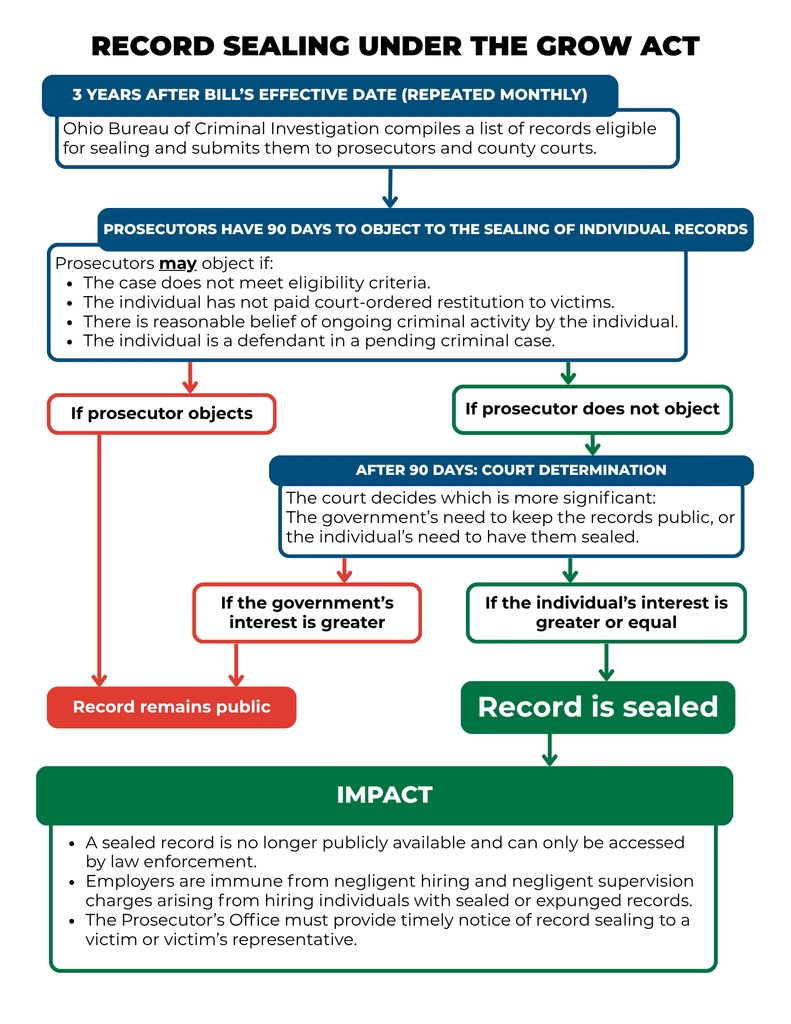
Felony-impacted people and other advocates have convinced Ohio legislators to introduce the GROW Act,[25] which would make Ohio one of 14 states (plus D.C.) with laws that allow for the state to initiate the record-sealing process, rather than requiring individuals to jump through hoops.[26] The GROW Act would make Ohio’s process more efficient, streamlined, and accessible for eligible individuals.[27] When similar legislation was initially proposed in 2024, it was estimated that approximately 1,071,000 Ohioans were eligible to have their records sealed.[28] Figure 1 displays the record sealing process outlined in the GROW Act.[29]
Figure 1
Conclusion
Passing the GROW Act would be a major step to help Ohioans with criminal records obtain employment, housing, and other key resources that are vital to success. Implementing a state-initiated record sealing process would help individuals with criminal records eligible for sealing live without the stigma of their criminal history holding them back.
However, record sealing is only one step to improving opportunities for individuals with criminal records—especially since eligibility requirements restrict many individuals from record sealing. Further work is needed to protect individuals with criminal records from discrimination, improve access to reentry resources in prisons and jails, and expand diversion programming. Ohio’s Certificate of Qualification for Employment (CQE)[30] and Certificate of Qualification for Housing (CQH)[31] are promising tools for providing relief from some collateral sanctions, but expanding eligibility requirements and simplifying procedural complexities is necessary to help more individuals access these resources. Ultimately, addressing barriers to opportunity for individuals with convictions will help Ohio become a more equitable, safe state where all Ohioans have opportunities to thrive.
[1] The GROW Act would change the process for record sealing, which removes the record from public view. The Act would not affect the process for record expungement, which erases the record entirely. See Ohio Revised Code sections 2953.32 and 2953.34 for more information about the effects of record sealing and expungement.
[2] “Collateral Consequences Inventory,” National Inventory of Collateral Consequences of Conviction, accessed July 16, 2026. The inventory identifies 1,062 collateral sanctions under Ohio law.
[3] At the time of the survey, 71% of all Ohio resident tax filers had W-2 employment. Data in this paragraph are all from “Fired, denied, rescinded,” Piet van Lier, Policy Matters Ohio, September 18, 2025.
[4] One study estimated that 39% of U.S. children born between 1999 and 2005 lived in such households. Keith Finlay et al., “Children’s Indirect Exposure to the U.S. Justice System: Evidence from Longitudinal Links between Survey and Administrative Data,” The Quarterly Journal of Economics 138, no. 4 (2023): 2181-2224.
[5] Annie E. Casey’s Kids Count Data Center.
[6] Elaina R. McWilliams and Bronwyn A. Hunter, “The Impact of Criminal Record Stigma on Quality of Life: A Test of Theoretical Pathways,” American Journal of Community Psychology 67, no. 1-2 (2021): 89-102.
[7] See Health Policy Institute of Ohio, “Connections between criminal justice and health: Insights on justice and race,” November 19, 2021, for more information about racism in Ohio’s criminal justice system.
[8] CSG Justice Center, “Ohio Criminal Justice Data Snapshot,” January 6, 2025, 34.
[9] See Luke Bo’sher, Sewin Chan, Ingrid Gould Ellen, Brian Karfunkel, and Hsi-Ling Liao, “Accessibility of America’s Housing Stock: Analysis of the 2011 American Housing Survey (AHS),” U.S. Department of Housing and Urban Development, May 26, 2015, for more information about the shortage of accessible housing in the U.S.
[10] See Housing & Residency consequences in the Collateral Consequences Inventory, National Inventory of Collateral Consequences of Conviction, accessed July 16, 2026.
[11] See Economy League of Greater Philadelphia, “Economic Benefits of Employing Formerly Incarcerated Individuals in Philadelphia,” September 2011. This study estimated that employing 100 previously incarcerated individuals would produce over $55 million in post-release lifetime earnings.
[12] Mark T. Berg and Beth M. Huebner, “Reentry and the Ties that Bind: An Examination of Social Ties, Employment, and Recidivism,” Justice Quarterly 28, no. 2 (2011): 382-410, as cited in “10 Facts About Employment,” Prison to Employment Connection, accessed July 22, 2026.
[13] See Prescott and Starr, “Expungement of Criminal Convictions,” Harvard Law Review 133, no. 8 (June 2020): 2513-2514. This Michigan study found that recidivism among expungement recipients is low: Just 3.4% of expungement recipients were rearrested and 1.8% were reconvicted of crimes within two years; 7.1% were rearrested and 4.2% were reconvicted within five years.
[14] See the Consumer Financial Protection Bureau, “Tenant Background Checks Market,” November 2022, for more information about how landlords use criminal records data in tenant screening.
[15] See the United States Commission on Civil Rights, “Collateral Consequences: The Crossroads of Punishment, Redemption, and the Effects on Communities,” June 2019, 65-70. According to this report, the U.S. Department of Housing and Urban Development (HUD) issued guidance in 1996 urging Public Housing Providers (PHAs) to use “one-strike” rules in screening and eviction procedures, so that any criminal activity by a member of the household could justify denial of housing. HUD later updated this guidance, emphasizing that PHAs are not required to adopt “one-strike” policies and clarifying that the usage of criminal records must align with Fair Housing Act standards. In 2025, HUD once again rescinded previous guidance, returning to the 1996 guidance. See Scott Turner, U.S. Department of Housing and Urban Development, “Letter to Public Housing Authorities and Owners,” Novogradac, November 25, 2025, for the most recent HUD guidance regarding criminal record screening.
[16] See Austin Cummings, Fair Housing Center for Rights & Research, “It was like repeatedly having a door closed in my face: experiences of finding housing with a criminal conviction in Cuyahoga County, Ohio,” 2025, 9.
[17] See USCCR, “Collateral Consequences,” June 2019, 72.
[18] See Cummings, Fair Housing Center for Rights & Research, “It was like repeatedly having a door closed in my face,” 2025, 14. The survey used in this report found that in the first six months following conviction, the top three places respondents found housing were with family members (52.8%), with friends (22.2%), and in shelters (22.2%).
[19] See the Center for Community Alternatives, “The Use of Criminal History Records in College Admissions Reconsidered,” 2010. The survey used in this report found that around 66 percent of all colleges require applicants to provide information about their criminal history during the application process. Specifically, 80.6% of private institutions, 74% of four-year institutions, 54.5% of public institutions, and 40% of two-year institutions require applicants to disclose any criminal history.
[20] See Center for Community Alternatives and Education from the Inside Out Coalition, “Boxed out: Criminal History Screening and College Application Attrition,” March 2015. This report, based on data from 30 State of New York (SUNY) schools, found a median “application attrition” rate of 62% for applicants with a felony conviction, compared to a median general application attrition rate of 21%.
[21] See Robert Stewart and Christopher Uggen, “Criminal records and college admissions: A modified experimental audit,” Criminology 58, no. 1 (2020):156-188. This study used comparable pairs of test applicants—one having no criminal history and the other having a prior low-level felony conviction—found that the rejection rate of applicants with criminal records was nearly 2.5 times the rate of their counterparts without a criminal record.
[22] See Ohio Revised Code sections 2953.32 and 2953.34 for more information about the effects of record sealing and expungement.
[23] See “Record Sealing and Expungement in Ohio,” Ohio Justice & Policy Center, March 2025, for a full overview of record sealing and expungement laws in Ohio.
[24] See J.J. Prescott and Sonja B. Starr, “Expungement of Criminal Convictions: An Empirical Study,” Harvard Law Review 133, no. 8 (2020): 2489. This Michigan study found that prior to the passage of Michigan’s state-initiated expungement laws, only 6.5% of individuals eligible for expungement received one within five years of eligibility.
[25] See Michele Reynolds, “Enact the Grow Act,” The Ohio Legislature 136th General Assembly, May 20, 2026, for full bill.
[26] “Clean Slate in States,” Clean Slate Initiative, accessed July 16, 2026.
[27] The GROW Act does not propose any changes to eligibility requirements for record sealing. Eligibility for record sealing is outlined in R.C. Section 2953.32.
[28] Brett Hillyer, “Ohio House Criminal Justice Committee- 4-3-2024,” HB 460 1st Hearing, The Ohio Channel, 22:43-23:06.
[29] See Reynolds, “Enact the Grow Act,” The Ohio Legislature 136th General Assembly, May 20, 2026, for full bill.
[30] See “Certificate of Qualification for Employment,” the Supreme Court of Ohio & the Ohio Judicial System, accessed July 22, 2026, for more information about CQEs.
[31] See “Certificate of Qualification for Housing (CQH),” Ohio Justice & Policy Center, May 2025, for more information about CQHs.