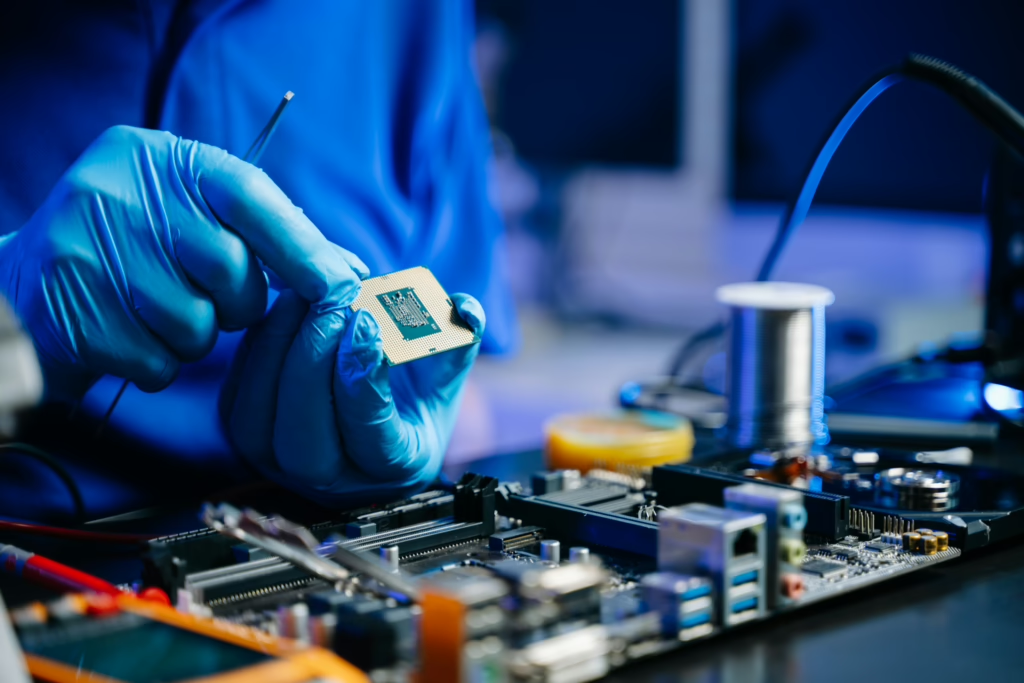
With projects like Intel’s Ohio One, our state has made big public investments in the semiconductor industry. Public policy can ensure that taxpayers’ dollars are used to benefit workers, families, and communities here in the budding Silicon Heartland.
In early 2022, Intel announced that they were going to “invest more than $28 billion in the construction of two new leading-edge chip factories” in Ohio’s Licking County. The fabrication plants (“fabs”) would be used to create semiconductor chips that power everything from cell phones to advanced military equipment. The project was billed as “the largest single private sector company investment in Ohio’s history.” Policy Matters was cautiously optimistic about the potential benefits for working people in Ohio, but the project is heavily subsidized and plagued by missed deadlines. Apple has recently entered a preliminary deal with Intel for Intel to produce some chips for Apple, which may provide a needed boost to Intel’s bottom line.
The project was partially supported by funding from the Biden Administration’s CHIPS and Science Act, which was meant to deploy dollars to onshore the booming semiconductor industry. The state of Ohio also provided a generous incentive package.
In 2025, the president withheld $5.7 billion in promised CHIPS grants to Intel, releasing the funds only when the corporation gave the U.S. government a 10% equity stake in the company. Intel has been struggling financially for years; the government stepping in is an attempt to stabilize the only American semiconductor manufacturer.
Exchanging public funding for stock equity is a strategy supported to some degree by progressive Senators Bernie Sanders and Elizabeth Warren. They attempted take such interest by an amendment to the CHIPS Act in 2022. By using taxpayer dollars to take an equity stake in the company, the American taxpayer has the potential to also benefit from any return on investment.
Intel initially promised a fixed asset investment of at least $20 billion by 2025, at which point it intended to have two fabs up and running. Fixed asset investments include, but are not limited to, buildings, software, computers, and other materials used to create goods and services that can be used for at least a year. Intel expected this initial phase of the project “to create 3,000 Intel jobs and 7,000 construction jobs over the course of the build.”
The corporation’s initial announcement enthused, “At full buildout, the total investment in the site could grow to as much as $100 billion over the next decade, making it one of the largest semiconductor manufacturing sites in the world.”
The corporation also announced “plans to invest approximately $100 million” in partnerships with universities, colleges, and the National Science Foundation to develop programs to train workers for the advanced manufacturing jobs the fabs would create. Other promises like investments in childcare were also made, but the federal mandate was waived an removed for Intel as part of the equity exchange, despite initial headway.
No. They have pushed back their deadline by at least five years and now say there may only be one plant open by 2030 — although it appears that Ohio’s Department of Development may not be aware of these changes. When asked if Intel had requested an extension, a representative from the Ohio Dept. of Development said, “Intel has not formally requested an extension from the State of Ohio. However, we remain confident that Intel will deliver on the commitments it has made, and we have every indication that the plants will become operational … Intel is still expected to meet its investment, job, and payroll commitments by 2028, and that has not changed.”
So far, Intel has spent a total of $5 billion in Ohio with $1.4 billion being spent in 2025 alone.
Of course! It breaks down like this:
It depends. The state cannot claw back the nearly $400 million spent on roads and other infrastructure, since that work is already done and the money already spent. The state can demand repayment of the $600 million grant if the facilities are not completed by the end of 2028 — though Attorney General Dave Yost says the grant agreement is “so broad you could drive an 18-wheeler through it.”
Absolutely. Legislators dropped the ball and mismanaged taxpayer resources. Policymakers should always insist on clear parameters and timelines for all development projects that get public assistance — and strict clawbacks to reclaim funding when corporations try to change the rules. Clawbacks ensure that taxpayer dollars are being used to benefit communities instead of being wasted, used fraudulently, or rolled into corporate profits.
Intel’s move into central Ohio has statewide impacts. Every dollar spent on wooing Intel is a dollar that’s not available for public schools, childcare, or targeted tax breaks that preserve critical revenue.
Ohio community colleges and universities have changed their curricula to accommodate the planned semiconductor industry. Ohioans have uprooted their families, sold their homes and moved to the New Albany area. Farmers report feeling pressure to sell their land.
Even Ohio’s landscape is changing, as the resource-intensive semiconductor industry impacts water- and air-quality for Licking County and surrounding areas.
In an attempt to preserve their communities, coalitions such as the Licking County Air Monitoring Network have popped up in the area. Participants monitor air pollution in communities surrounding the Intel site with the goal of holding Intel accountable and ensuring that their neighborhoods won’t turn into a dumping ground for tech waste.
CHIPS Communities United is a nationwide coalition organizing for an equitable and sustainable semiconductor manufacturing industry. Visit their website for more info.
The Ohio CHIPS Coalition monitors Intel developments in our state. To learn more, sign up for our monthly newsletter, CHIPS Ahoy!
The Ohio CHIPS Coalition is here to keep you up to date on projects funded by the federal CHIPS and Science Act — especially Intel’s “Ohio One” project — with a focus on what you can do to help ensure they become models of high-road economic development.
Policy Matters staff are always happy to field questions about this and all our work. Please don’t hesitate to reach out using this form.