
UPDATE: Learn how federal funding cuts will harm Ohioans who depend on LIHEAP.
The Low Income Home Energy Assistance Program (LIHEAP) is a federal block grant program administered by the U.S. Dept. of Health & Human Services (DHHS) Office of Community Services. LIHEAP has helped alleviate energy burdens (the percentage of household income spent on home energy costs) for low-income households by covering energy bills, weatherizing homes, or financing minor energy-related home repairs since 1981.[1] In Ohio, LIHEAP funding flows through the state’s Home Energy Assistance Program (HEAP).[2]
How do federal funds reach Ohioans?
At the federal level, LIHEAP involves two funding categories:
Regular funds: Block grants determined by a statutory formula considering state-level contexts for low-income households’ expenditures on home energy, including home heating and cooling costs. The method for allocating regular funds to states is contingent on the total funding appropriated by Congress in a given fiscal year.[3]
Emergency contingency funds: Additional funding allocated by the President or the Secretary of HHS in response to emergency needs, like a natural disaster or other event generating greater household energy insecurity.
In each fiscal year, state grantees must obligate[4] at least 90% of their LIHEAP funds, and may carry over 10% to the next fiscal year. Unobligated balances exceeding 10% of a state’s regular funding will be returned to DHHS and reallotted in the following fiscal year.[5]
In FY23, DHHS released $256.4 million in federal LIHEAP funding for HEAP in Ohio.[6] Combined with reallotment funds and carryover funds from FY22, total LIHEAP funding for Ohio amounted to $263.0 million.
Federal LIHEAP administrators allocate block grant amounts to state grantees responsible for designing and carrying out a statewide energy assistance program. Currently, Ohio’s LIHEAP allotment is released to the Ohio Department of Development, which disburses HEAP sub-grants to local service providers in Ohio’s network of Community Action Agencies, with offices in each county. For example, Mahoning Youngstown Community Action Partnership serves Mahoning County, and IMPACT Community Action, serve Franklin County. These agencies conduct outreach to eligible households, help applicants apply for benefits, and process their applications. After an application has been approved, HEAP providers apply participants’ benefits to their utility balance, paid directly to their respective utility company.
The map below shows the distribution of sub-grants delivered by the Ohio Department of Development to local HEAP providers.[7]
Figure 1: HEAP funding distribution, FY 2024

How can Ohioans use HEAP?
State energy assistance programs must include certain program components to comply with the LIHEAP statute and qualify for funding, with flexibility for state-by-state variation in program design. States must offer regular and crisis assistance programs, and have the option to allocate up to 15% of LIHEAP funds to energy conservation measures. States set the income eligibility and application periods for each. Ohio’s program covers regular heating assistance, summer and winter crisis assistance, and weatherization benefits.
| LIHEAP component | Ohio’s program |
| Regular assistance States must provide either home heating or cooling benefits in the form of utility bill assistance. Some provide both. | Ohio provides regular assistance for heating but not cooling. Benefits are paid directly to households’ utility providers. |
| Crisis assistance States must set aside a portion of LIHEAP funds to intervene in crisis situations, providing assistance to households at risk of losing home energy services, or those that have already lost services. States may run summer and/or winter crisis assistance programs, or year-round crisis assistance. States must provide crisis assistance to all eligible households within 48 hours of receiving an application, and within 18 hours for households in a life-threatening situation.[8] | Ohio provides both summer and winter crisis assistance, defined[9] as follows: Summer crisis: “Disconnection, notice of disconnection, establishing new service, less than 25% supply of deliverable fuel, or a heating system needing repair to be operable are criteria to be considered in crisis.” Winter crisis: “Disconnection, notice of disconnection, establishing new service, a medical certification and/or being elderly (age 60 or older) are criteria to be considered in crisis.” |
| Weatherization benefits States may provide assistance for energy-saving home improvements or other energy conservation measures to lower residential energy bills. Home weatherization measures improve energy efficiency and reduce home energy use. In their state LIHEAP plans, states may select from a menu of weatherization measures provided using LIHEAP funds, including funds for rooftop solar installations or community solar projects. | Ohio’s program includes weatherization needs assessments or audits; energy-related roof repair; caulking and insulation; major appliance repairs or replacements; storm windows; heating system modifications, repairs, or replacements; cooling system modifications, repairs, or replacements; windows or sliding glass doors; doors; water heaters; and water conservation measures. Ohio’s plan specifically excludes rooftop and community solar. |
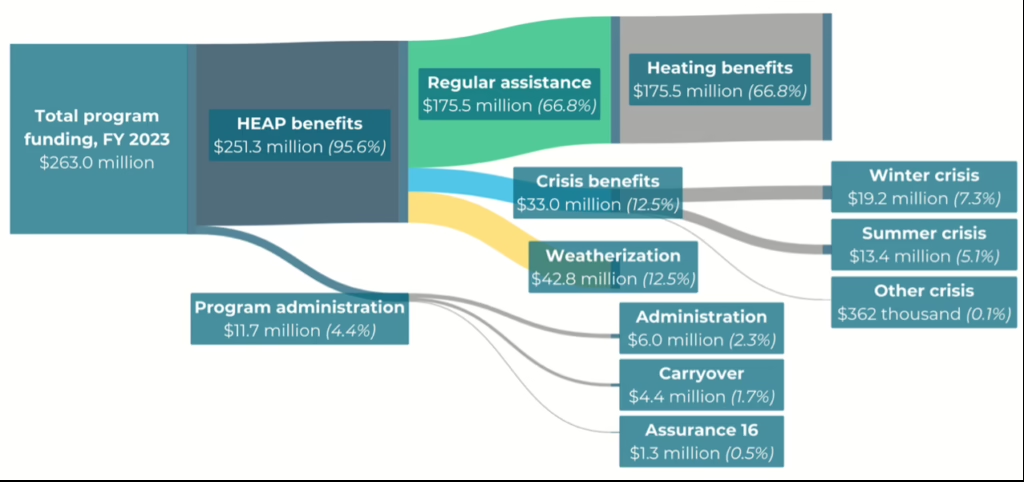
The figure below shows the distribution of Ohio’s LIHEAP funding allotment for FY 2023, by major program component. Of the $263 million delivered to Ohio to carry out the statewide energy assistance program, the Department of Development allocated 95.6% to direct assistance provision, including funding for regular bill assistance, weatherization, and crisis program assistance benefits. The remaining 5.4% of LIHEAP funding was used for general program administration and coordination at the state level.[10]
Figure 2: Distribution of Ohio’s LIHEAP funding in 2023
The table below provides an overview of the major program components described by Ohio’s detailed model plan[11] for administering HEAP using FY 2025 LIHEAP allotments.[12]
Figure 3: Program components in Ohio’s model plan
| Income eligibility cap | Income limit for a family of 4 | Max. benefit | Operation dates | % of funding | ||
| Regular assistance | Heating* | 175% of FPL | $54,600 | $811 | Oct. 1- May 31 | 37.5% |
| Crisis assistance* | Winter | 175% of FPL | $54,600 | $1,200 | Nov. 1 – Mar. 31 | 15% |
| Summer | 175% of FPL | $54,600 | $800 | July 1 – Sept. 30 | 15% | |
| Weatherization | 200% of FPL | $62,400 | $8,497 | Oct. 1- May 30 | 15% | |
*For both heating and crisis assistance, the income limit for households with eight or more members is 60% of the state median income (SMI), while households with seven or fewer members must meet eligibility requirements determined using federal poverty guidelines. In Ohio, 60% of the SMI for a family of eight is $90,515, compared to $92,260 using federal poverty guidelines, meaning a slightly higher share of large households qualify for HEAP services using SMI limits.
How has HEAP benefited Ohio households?
Over the past five years (FY2019-23), DHHS has provided HEAP an average of $292.9 million per year to deliver energy assistance services to Ohio families, alleviating outsized energy burdens for nearly 258,000 households each year, on average.
In 2023, HEAP participants had an average annual energy burden of 22.4% before receiving assistance – the second-highest average in the nation. Among households designated as “high burden,” the average energy burden was 104.5%[13] – meaning HEAP recipients with the highest energy burdens are simply priced out of the market for residential home energy services. The same year, HEAP recipients saw a 2.9 percentage point reduction in their energy burden after receiving assistance, and households with the highest energy burdens saw an average reduction by 8.0 percentage points. HEAP restored home energy services for 6,831 households experiencing bill payment issues, while maintaining services for 83,271 households at risk of disconnection.
How can Ohio make HEAP work for more Ohioans?
Despite the critical support it provides to households with high energy burdens, Congress has underfunded LIHEAP since its inception. As a result, families who qualify for help meeting their energy needs often can’t access assistance, especially during periods of high demand for services.
Between 2019 and 2023, HEAP served only 18.6% to 23.0% of eligible households. Many eligible households underserved by LIHEAP often forego other household necessities, like groceries or healthcare expenses, or risk utility disconnections due to nonpayment.
Roughly 1.3 million Ohio households were eligible for energy assistance delivered by Ohio’s program in 2023. Among the income-eligible households in Ohio:
41.3% live below the federal poverty line.
Utility debt has wide-ranging implications for housing and food security,[14] including the loss of housing vouchers.[15]
44.3% have a household member aged 60 or older.
Older populations are particularly vulnerable to health risks due to unsafe indoor temperatures in both the summer and winter months.
43.0% have a household member with a disability.
Many depend on electric-powered medical devices to navigate life with a disability. Individuals with a spinal cord injury, or those taking certain medications to treat other conditions, also face difficulties with internal body temperature regulation.
15.3% have a child five years or younger.
Ohio’s kids face greater health risks when exposed to harmful indoor air pollutants produced by alternative heating equipment – like stoves, ovens, or space heaters – to reduce home energy use and cope with unsafe winter temperatures.
Despite existing funding needs, Ohio can improve access to and uptake of energy assistance benefits by modifying certain program design elements. First, Ohio recently launched an online application portal to streamline application processes, enabling applicants to submit all necessary documentation online. However, households with high energy burdens are less likely to have reliable internet access, especially in rural communities. As a result, families without internet services may have lower program awareness or greater difficulties navigating the application process. Enhancing coordination across programs through joint applications and enhanced intake referrals to or from other assistance programs would promote program awareness and participation.
To further improve HEAP access, Ohio should also integrate income eligibility verification across multiple programs by determining “categorical eligibility” for households receiving benefits through other public assistance programs – meaning households enrolled in programs like SNAP, TANF, or SSI would be automatically eligible for HEAP. For example, some states automatically approve applicants enrolled in other programs, while Maryland automatically enrolls beneficiaries of SNAP, TANF, and SSI in its energy assistance programs.[16] However, Ohio does not identify categorical eligibility for any program in its state LIHEAP plan. Categorical eligibility determinations alleviate administrative burdens for both applicants and intake workers, reducing paperwork and eligibility verification review wait periods for families in need of multiple types of assistance.
Finally, though some states offer both heating and cooling assistance, Ohio only delivers cooling benefits in crisis situations, with no summer disconnection protections for low-income households.[17] Including a cooling program component in Ohio’s LIHEAP plan would improve health and safety outcomes for households with high energy burdens, especially as dangerous heatwaves become more frequent in a changing climate. However, insufficient federal LIHEAP funding and unprecedented heat waves further necessitate state policies that expand utility shutoff protections in the summer.
[1] LIHEAP took the place of its predecessor under the same name, with a different acronym (LIEAP), a program that ran through the 1970s. See the LIHEAP Clearinghouse’s “History of LIHEAP.”
[2] Home Energy Assistance Program (HEAP), Ohio Department of Development.
[3] The methodology to determine the “new” formula percentage for each state considers its respective total residential energy consumption, temperature variation, heating and cooling consumption levels, low-income household heating and cooling consumption, and total spending on heating and cooling. The actual percentage of LIHEAP funds allocated to each state depends on total appropriations levels in a given fiscal year, and corresponding “hold-harmless provisions” in the LIHEAP statute, which adjust the new formula percentages to guarantee sufficient funding for states with reduced percentages determined by the new formula. The Congressional Research Service offers a detailed account of how LIHEAP funds are allocated to states using the statutory formula.
[4] Obligations are different from program expenditures. According to the Code of Federal Regulations (2 CFR 200.1), obligation means “orders placed for property and services, contracts and subawards made, and similar transactions that require payment by a recipient or subrecipient under a Federal award that will result in expenditures by a recipient or subrecipient under a Federal award.” However, the definition of obligation used to determine states’ carryover amounts may vary depending on definitions provided in respective state LIHEAP plans.
[5] “How a Decades-Old Federal Energy Assistance Program Functions in Practice: A Deep Dive into LIHEAP,” by Scott Bechler. Nicholas Institute for Energy, Environment & Sustainability at Duke University. April 2021.
[6] Ohio receives additional home weatherization funding from the U.S. Dept. of Energy’s Weatherization Assistance Program (WAP). The Dept. of Development uses LIHEAP funds allocated to weatherization measures to leverage WAP funds in implementing Ohio’s statewide Home Weatherization Assistance Program (HWAP).
[7]HEAP sub-grant amounts are drawn from the Ohio Department of Development Grants & Loans dataset, aggregated to local HEAP providers’ service area. Note: Though local HEAP providers have an intake site in each County, County-level grant data were not available for those served by one provider if the provider’s main office were based in a different County. For example, Bridges Community Action Partnership serves Champaign, Delaware, Logan, Madison, and Shelby Counties, and funding data were only available for Union County. Each County is served by one HEAP provider, with the exception of Cuyahoga and Franklin Counties, with two providers each.
[8] LIHEAP Statute and Regulations, Sections 2604(c)(1) and 2604(c)(2).
[9] Winter crisis and summer crisis definitions found in Section 4.2 of Ohio’s FY25 LIHEAP plan.
[10] LIHEAP’s Assurance 16 provision supports state investments in educational programming to improve program awareness and energy self-sufficiency among households who qualify for federal energy assistance. The Ohio Department of Development uses up to 5% of its LIHEAP allotment to fund Assurance 16 activities, partnering with local community action agencies and other nonprofits to provide energy efficiency education programming and resources to help lower HEAP recipients’ home energy use.
[11] Winter crisis and summer crisis maximum benefits found in Section 4.12 of Ohio’s FY25 LIHEAP plan.
[12] State grantees identify income eligibility limits, funding levels, and target populations for each program component in a state’s respective LIHEAP plan. Funding shares detailed in state LIHEAP plans may not align with funding allocations from previous fiscal years.
[13] Researchers use a 6% threshold to define “high” energy burdens, and 10% for “severe” energy burdens. Though LIHEAP reporting mechanisms disaggregate performance data across all households and high burden households, an average energy burden of 22.4% across all households suggests most HEAP recipients had a severe energy burden regardless of inclusion in the high burden category.
[14] “Housing costs are not a monolith: The association between neighborhood energy burdens and eviction filing rates.” Megan E. Hatch and Michelle Graff. Cities, 150, 104995. 2024.
[15] “Reasons why Section 8 vouchers can be taken away,” Illinois Legal Aid Online, 2020.
[16] LIHEAP Categorical Eligibility: States and Territories, LIHEAP Clearinghouse.
[17] “Summer Shutoff Protections and Bill Support Fail to Adapt to a Warming World,” prepared by the Center for Energy Poverty and Climate and National Energy Assistance Directors Association, July 2024.