
“Ohio’s childcare crisis” was originally published in March 2024. The 2025 version updates data but is otherwise unchanged, except where additions are highlighted.
Childcare should be a top priority for Ohio policymakers. A recent poll[1] found that for Gen-Z workers, childcare benefits are ranked more important than even health insurance benefits in the workplace. Childcare is vital to millions of families in Ohio, but there are many barriers to access, the early childhood educators providing care are grossly underpaid, and childcare is simply unaffordable for most Ohioans.
Our labor force is stronger when parents can go to work knowing their kids are cared for. When childcare providers can afford to hire and retain skilled staff, they can keep our children safe and give each child the attention they deserve. Everyone benefits when childcare workers — who are disproportionately women and disproportionately Black — can afford high-quality care for their own kids.
To get childcare right, Ohio leaders need to balance the needs of those three groups — parents, providers and workers. For too long, policymakers have gotten it wrong, and the littlest Ohioans suffer the consequences.
The average annual cost for one infant’s childcare in Ohio is $10,417[2]—that’s $868 per month! For $10,417 in annual childcare costs to be affordable (as defined by the U.S. Department of Health and Human Services),[3] a family of three with two parents and one infant would need an annual income of $148,814. Put another way, two parents would have to each make $35.77 per hour working full time to make childcare affordable at the average rate, for just one infant.
Key findings
- Ohio now has the third lowest eligibility for Publicly Funded Child Care in the country for kids 0 to 5.[4] Ohio used to be in last place – until the depletion of American Rescue Plan Act monies caused other states to lower their eligibility, bumping Ohio up to third place for the same age group at 145% FPL.
- Between 2019 and 2023 (the most recent figure available), the number of children benefiting from publicly funded childcare in Ohio dropped by 32,000, from 172,585 children to 140,585.[5] Publicly funded childcare enrollment peaked ten years ago in 2014 at 181,703 and has declined since.
- From 2017 to 2023, the number of childcare workers in Ohio dropped by 31.94%, with the biggest decrease of nearly 5,000 workers happening between 2019 and 2020.[6] Many areas around the state simply have not recovered from this loss of workforce and many remaining childcare facilities are at a high risk of closure because lack of state investment has resulted in razor thin margins keeping wages low while costs continue to increase.
- The median hourly wage for childcare workers in Ohio is $13.44 — an annual salary of $27,960 for those working full time.[7] For comparison, the median for all workers in Ohio was $23.95 an hour in 2023,[8] with 13.3% of Ohioans living in poverty.[9]
- The amount the state reimburses childcare providers per child is not based on the actual cost of childcare, but rather on a backward-looking market rate survey of what providers recently charged for services in an area.[10] This rate is important because it determines the amount of money providers receive and therefore their ability to stay open, improve facilities, and pay providers a living wage.
- 39% of Ohioans live in a childcare desert. A childcare desert is any census tract with more than 50 children under age 5 that contains either no childcare providers or so few options that there are more than three times as many children as licensed childcare slots. 41% of white Ohioans, 37% of Hispanic or Latino Ohioans, and 29% of Black Ohioans live in a childcare desert.[11] In Ohio, childcare deserts are most prevalent in rural areas.
- Affordable childcare lets parents work. According to a poll done in 2024 by Groundwork Ohio[12] 61% of parents who are not working full time would do so if childcare was more affordable.
Across America, other states are also feeling the effects of this childcare crisis. In 2021, Secretary of the Treasury Janet Yellen shared her analysis:
The free market works well in many different sectors, but childcare is not one of them. It does not work for the caregivers. It does not work for the parents. It does not work for the kids. And because it does not work for them, it does not work for the country.[13]
Ohio legislators through neglect, underfunding, and an insufficient response to the sector’s needs have created the current childcare landscape in Ohio, including the low wages, tiny margins, and high turnover common in the sector. It is a system that serves no one well. Policy makers can and must do better for Ohio’s children. Sensible policy solutions, informed by all stakeholders, can guide a comprehensive approach to the reforms Ohio’s children, families, and childcare workers need.
Recommended reading: The First Five Years Fund’s Early Education in Ohio Fact Sheet.
Publicly Funded Child Care
Publicly Funded Child Care (PFCC) is a state program administered by Ohio Department of Children and Youth that uses state and federal funding to subsidize childcare for families who are income eligible. In Ohio, families can initially enroll in PFCC if their gross monthly household income is at or below 145% of the federal poverty level:[14] $3,220 per month or $38,643 annually for a family of three. Once enrolled, they can remain eligible as they grow their income, up to 300% of the federal poverty level: $77,460 annually for a family of three.[15] Currently, 9,925 children benefit from this phase-out.[16] The state reimburses providers directly for childcare and families contribute a weekly copayment. Each week, the state sends providers a check to cover all or a portion (if families have a copay) of the cost of care for PFCC-participating kids in the previous week. For families under the Federal Poverty Level (FPL), that weekly copayment is $0.[17]
Types of providers
Ohio childcare providers must enter into a provider agreement with the state and provide financial information to participate in PFCC. As of January 2025, just 54% of Ohio’s 8,416 childcare providers were participating. (See Figure 1 for more detailed data.) The state categorizes providers according to various factors.[18] Understanding these categories is key to Ohio’s systems and data reporting.
Childcare centers provide care for more than seven children in a facility that is not a private home. They have at least one employee and are licensed by the Ohio Department of Jobs and Family Services (ODJFS).
In-home care providers are either Type A or Type B. For both types, children under 6 who are family members of providers must be included in count size.
- Type A providers care for up to 12 children at one time and must maintain a ratio of at least one staff member for every six children, with each staff member caring for no more than three children under age 2.
- Type B providers care for up to six children with no more than three under age 2. Type B providers do not have employees.
In-Home Aides (IHA) are home care providers who can serve multiple families and must be certified for each home every two years.
Day camps care for school-age children during school breaks including summer.
Ohio Department of Education (ODE) providers funded by PFCC include licensed preschools and licensed school-age care:
- An ODE Licensed Preschool is operated by a public, private, or charter school, or a county board of developmental disabilities.
- An ODE Licensed School Age Child Care program provides before and after school care at a public, private or charter school.
Figure 1
Childcare is unaffordable for most Ohio families
The U.S. Department of Health and Human Services defines childcare as “affordable” if it costs 7% or less of a family’s annual income.[19] By that measure, a typical Ohio household can afford to spend $4,880 a year on childcare.[20] Compare that to the actual average costs[21] of childcare in Ohio:
- For infants 12 months or younger: $12,989 at a childcare center and $9,700 at a home-based provider.
- For toddlers ages 13-36 months: $11,681 at a center and $9,239 at a home-based provider.
- For preschoolers ages 37 months–5 years: $11,334 at a center and $8,278 at a home-based provider.
At these rates, a family would have to make $352,428 (1100% of the FPL!) a year to afford care for an infant and a toddler at the average childcare center. In other words: It would take the typical Ohio family about five years and three months to have enough income to afford just one year of childcare for their two kids. At the FPL, a family of four in 2025 would have to work nearly eleven years to afford the same.
If a parent, working full time, has one infant and one toddler at an average cost childcare center, then $11.86 of every hour they work would go to childcare costs. For comparison, the minimum wage in Ohio is $10.70 per hour.
FAQ: Where did the 7% federal benchmark for childcare affordability come from?
In 2014, the Child Care Funding Block Grant set new standards for how states could use federal funds. During that process, a study from the U.S. Census Bureau found that “from the percent of family monthly income spent on childcare has remained relatively constant between 1997 and 2011, at around 7 percent.” This study became a common benchmark for affordability and was later adopted as a federal benchmark by HHS in 2016.
For more information on the federal guidance, see the July 11, 2023 White House release titled “FACT SHEET: Vice President Harris Announces Actions to Lower Child Care Costs and Support Child Care Providers.”
When people can’t afford to start a family on less than $350,000 a year, their options are limited. Many choose to leave for states where they can count on higher incomes and stronger public support. Many choose not to have kids at all. For a variety of reasons, this is already happening: Ohio’s population is shrinking and aging.[22] Likely in part because, in Ohio, childcare is a luxury, unaffordable even for middle-income families. Ohio’s economy, families, and future cannot afford that status quo.
Recommended reading: The Center for American Progress has an interactive map that shows the relationship between poverty and access to childcare.
Let’s compare: A two-parent household with both parents working full time at Ohio’s minimum wage will make $44,512 in 2025.[23] With two kids in childcare,[24] this family could expect to pay about 55% of their income for childcare at a center without financial assistance. Fortunately, this family would just qualify for assistance and would pay a monthly co-pay of $329.98, which is still 9% of their income:[25] close to but still not affordable.
A solo parent making the household median ($69,680) is above the self-sufficiency standard for many Ohio counties.[26] That parent would not qualify for Publicly Funded Child Care for their infant: They could expect to pay about 13.9% of their income at a Family Care Home (Type A or Type B home-based provider), about double the affordability benchmark of 7%.
Figure 2
The heart of the issue: What’s the problem in Ohio?
Unaffordable childcare is only part of the problem. Families, childcare workers, and providers face challenges that intersect and complicate one another. The result is a childcare system that too often fails all of us. Multiple problems that impact both providers and families include low pay for early childhood educators, childcare access limitations across populations, and race and gender-based devaluation of work. These issues are key to understanding how we got here and where we need to go.
Low rates for providers
To understand Ohio’s childcare crisis and the policy solutions we propose, you have to understand the state’s “reimbursement rate.” The details are complex, but the big picture is simple: the State of Ohio does not reimburse childcare providers nearly enough to stay in business while paying their staff a livable wage.
What is a reimbursement rate?
A reimbursement rate[27] is the amount providers receive from the state for each child in publicly funded childcare. It is calculated based on age of the child, county location, and quality level of the program.[28] The exact amount of the payment is set by comparing the prices charged for similar care by similar programs in the county. The state’s reimbursement rate falls somewhere between the lowest and the highest of those prices. Where it falls on that scale makes a big difference. Some states set their rate right in the middle, at the median: Half of all the similar centers in the county charge more, and half charge less. In technical terms, that is the “50th percentile” (because 50% charge less). Ohio was required by the federal government to increase their reimbursement rate to the 50th percentile, which went into effect in June 2024.[29]
Think about it like this: If there are 100 childcare programs in a county and each childcare program is put in order with the cheapest program at the top and the most expensive program at the bottom of the list, then the 25th program on the list is the 25th percentile and the 75th program on the list is the 75th percentile.
Providers can get a rate bump by participating in Step Up to Quality (SUTQ) — Ohio’s quality rating system — or programs that support children with disabilities.[30] That increase means the reimbursement will be closer to the actual cost of caring for a child.
Because children with disabilities may require special accommodations, providers receive up to double the reimbursement rate per disabled child in their care. While this does help PFCC families with disabled children, it does not go far enough: The Center for American Progress found in 2020 that “parents of young children with disabilities are three times more likely to experience job disruptions because of problems with childcare.”[31]
Another factor: Location
The reimbursement percentile is the same throughout the state, but its monetary value changes depending on location,[32] because the reimbursement rate is based on what similar providers are charging in similar locations[33] around the state. The differences are worth noting.[34]
- For full-time childcare at a center or Type A home-based provider, reimbursements range from $142 a week up to $368.75 a week per child, depending on SUTQ rating, location, and age of child.
- For full-time childcare at a Type B home-based provider, reimbursements range from $140.98 a week up to $220 a week per child, depending on SUTQ rating, location, and age of the child.
Low reimbursement rates make it more difficult for providers to pay staff a living wage and provide benefits. The median hourly wage for childcare workers in Ohio is $13.44.[35] For comparison, the median for all workers in Ohio was $23.95 an hour in 2023.[36]
Action for Children surveyed childcare providers in Central Ohio and found that 46% of family childcare professionals reported they would like to hire staff, but most (57%) report they are unable to pay staff. Over half (55%) of childcare providers reported monthly revenue does not cover their expenses. Of those family childcare professionals who are able to pay themselves a salary, the average monthly salary is only $1,595. (Working 40 hours a week, that’s $9.20 an hour: less than the state’s minimum wage.) Not only are many providers struggling to make a living wage, they’re also unable to provide their employees with the benefits that people need to survive. The same Action for Children survey found that only 36% of central Ohio childcare centers offer health, dental, or vision insurance for their staff.
Recommended reading Action for Children’s Central Ohio Child Care Provider Report gives a snapshot of the issue in Central Ohio.
Limited access
Even if childcare were more affordable, many families would not be able to access it. Parents and guardians who work outside normal business hours, and those who live far from the nearest provider face practical obstacles as well.
Hours of operation
For people working second shift or overnight, there are fewer publicly funded childcare options. Out of all childcare centers that accept PFCC, only 10% operate between 7pm and midnight, and only 7.90% operate between midnight and 6am.[37] Some of Ohio’s most common jobs require work during these hours. Many nurses, for example, face this barrier. Nursing is one of the few well-paying jobs in which women are disproportionately represented;[38] it is not an option for those without reliable childcare when they need it.
Distribution
For many Ohioans, there simply aren’t any licensed childcare providers nearby — or they don’t have capacity to serve all the children who need them. In rural areas especially, licensed childcare slots are literally too few and far between.[39]
Rural voters know the importance of childcare: A national poll in 2022 found that the vast majority (70%) see the issue as important to strengthening the economy. More than half (55%) say the availability of high-quality and affordable childcare has gotten worse since the pandemic.[40] But policymakers have failed to meet the demand: 60% of Ohioans in rural areas live in census tracts where there are more than three children under age 5 for each licensed childcare slot.[41]
Ohio’s demographics are key to understanding this issue. The Columbus Metro Area is home to 18% of the state’s population[42] and has 679 available childcare facilities that accept Publicly Funded Child Care (combining centers and Type A and B homes).[43] In all 32 counties of Appalachia (17% of the state’s population),[44] there are just 453. As of March 2025, of the 32 Appalachian counties, 8 have three centers or less, and two—Harrison and Noble–have zero.[45]
Figure 3 represents PFCC facilities, as of March 2025. For the most up to date numbers and programs in 2025, check out Ohio’s Early Childhood Program Locator Tool.
Figure 3
Systemic identity-based inequity also affects a family’s ability to access care. A 2020 study by Children’s Health Watch[46] found that compared to white parents, Black parents were 21% more likely to encounter problems with childcare access that were significant enough to interfere with their work or education. Latine[47] parents were 23% more likely and parents of other races were 38% more likely.[48] A 2022 survey by the Center for Economic and Policy Research found that LGBTQ+ parents of young children were 12 percentage points more likely than non-LGBTQ+ parents to have trouble finding childcare.[49] The intersecting factors that create these disparities are much more complex than the distance to a center or its hours of operation, but the result is the same: Too few Ohio parents could access childcare, even if it were more affordable.
Gender, race, and the value of work
Early childhood educators are essential to Ohio’s economy. But 95% of the childcare workforce is made up of women,[50] and like other industries disproportionately powered by women, childcare is undervalued and workers underpaid. That is in part because childcare has historically been (and often still is) treated as inherently “women’s work,” and like other domestic labor, often done for no pay at all. The result is a system that devalues certain skilled jobs simply because of who performs it.
Recommended reading “The Devaluation of Care Work is By Design” by Angela Garbles and “Black Women’s Labor Market History Reveals Deep-Seated Race and Gender Discrimination” by Nina Banks.
Racial disparity intersects here: Black Ohioans are more likely to be childcare workers than their counterparts of other races, making up 18.6%[51] of the childcare workforce but just 12.5%[52] of the state’s population. Economy-wide, Black women are more likely to be pushed into the lowest paying jobs,[53] one of which is childcare. Black people in early childcare settings are less likely than other early educators[54] across racial and ethnic groups to earn more than $15 per hour. Even compared to other underpaid educators, childcare workers are undervalued. According to the Economic Policy Institute, early childhood educators with a bachelor’s degree are paid 26.5% less than their colleagues in the K–8 system. The poverty rate for early educators in Ohio is 20.6%, more than 9 times the rate for other teachers (2.2%) and twice the rate for Ohio workers in general (10.3%).[55]
The numbers illustrate the compounding effects of racism, gender discrimination, and poverty. There’s a direct line from the historic devaluation of domestic labor and the enslavement of Black women[56] to the reality of many childcare workers today.
Children benefit when they receive care from a consistent set of caregivers.[57] But low wages and inadequate benefits drive high turnover in the childcare workforce, disrupting and degrading the quality of care our kids receive. To create a childcare system that works for every family, we need policy crafted to make early childhood education a viable career path for more Ohioans. That includes paying women — especially Black women — at a rate that reflects the high value of the work they do.
Other states have found solutions
Some states have taken action to increase access to quality childcare, raise childcare worker pay, and make childcare more affordable for working families. Ohio should learn from their successes and implement policies to not only stabilize the crisis, but to build a robust, equitable childcare system that prioritizes early childhood educators, children, and families.
Ohio lags other states in the Midwest. For infant center-based care, states like Kentucky reimburse providers in the 92nd percentile, West Virginia in the 80th, and Michigan in the 87th percentile.[58] These states represent a range of possibilities and the need for creativity when solving the childcare crisis. Other states have found ways to fund, reform, and reduce harm caused by the ongoing crisis, Ohio can too.
Kentucky
Publicly Funded Child Care in Kentucky is run through the Kentucky Child Care Assistance Program, which is fully accessible online.[59] The program has a workforce requirement for part-time and full-time workers to meet income qualifications. Full-time students, teen parents, and people who have eligibility through SNAP have their work requirement waived. The work requirement can also be met through studies to obtain a GED. Kentucky is also providing free childcare to childcare workers regardless of income to stabilize the workforce and has seen significant success: Since implementing the change, the number of children receiving state subsidies has more than doubled to 40,000,[60] including 5,200 children of staff members.[61]
Tennessee
Publicly Funded Child Care in Tennessee is part of the One Department of Human Services system,[62] allowing people to apply for services in one place. The Smart Steps childcare program[63] includes families with income below 85% of State Median Income (246% FPL)[64] who are also part of the teen parent program, have children six weeks to five years old, or who work or go to school, or both, for 30 hours or more a week. This year, the state improved their assistance programs by raising reimbursement rates for licensed agencies and increasing infant and toddler assistance for families.[65]
Maine
In Maine, the Right from the Start coalition has brought together a broad coalition of organizers, advocates, policy experts, parents, labor partners, and childcare providers working towards the same vision to invest in early childhood.[66] Priorities include expanding access to childcare, building a connected and coordinated system to access services, and ensuring that wages and benefits for childcare workers reflect the importance of their work and experience.
In 2023, Maine passed a state budget that includes historic investments in childcare. Effective October 19, 2024, eligibility is now up to 125% of the state’s median income ($141,574 for a family of four).[67] And a wage stipend begun during the COVID-19 pandemic was doubled from $200/month to $400/month on average.[68] If Ohio had a similar threshold, a family of four making up to $143,241 (125% of the state’s median income) would have access to assistance.[69]
As a result of this legislation, the state is also undertaking a long-term cost of care analysis to learn what it actually costs to sustain a high standard of childcare.[70]
New Mexico
In New Mexico, a diverse and dedicated coalition of grassroots organizations, policy experts, early childhood advocates, parents, and providers have been working for over a decade to address childcare issues in the state.
In 2020, legislation was passed to establish an early childhood trust fund as a permanent source of revenue that also created a cabinet level Early Childhood Education and Care Department.[71] The legislation increased the rate that the state pays to providers, expanded eligibility for the state’s Child Care Assistance[72] program to 400% FPL and eliminated co-pays for families.
This robust eligibility threshold, combined with the elimination of co-pays, means that a family of four making up to $128,600 a year will qualify for free childcare.[73]
The coalition identified New Mexico’s Land Grant Permanent Fund (LGPF) as a possible funding source and took their childcare campaign to the ballot in November of 2022. Coalition organizations drove a massive voter education and get out the vote effort and 70% of voters approved.[74] New Mexico Constitutional Amendment 1, allocating a percentage of the LGPF to early childhood and K-12 education. The LGPF is funded by oil and gas development on public land. New Mexico Voices for Children estimated that it would provide $150 million a year for New Mexico’s children and families.[75] In 2025, New Mexico allocated $250 million a year due to the success of the program and increasing research around the importance of investing in high-quality childcare.[76]
New Mexico continued to lead the nation in solving the childcare crisis and working to ensure parents, children, and childcare providers all have their needs met by updating rules around state reimbursement rates for providers. Reimbursement rates increased across facility types and capacity, sometimes by $200 or more per child per month.[77]
Recommendations
Around the country, states are making childcare easier to access and more affordable for families; directing more resources to childcare providers; and improving pay for childcare workers. Based on what’s worked in other states, here are recommendations for improving childcare in Ohio.
Raise the income threshold for PFCC to make more families eligible.
Ohio must expand access to affordable childcare by making all families paid up to 300% of the federal poverty level (or $6,662 per month and $79,950 annually for a family of three) eligible for publicly funded childcare.[78] At 300% FPL, Ohioans at the median household income ($69,680) would actually qualify for assistance.
Currently Ohio families qualify for PFCC if their gross monthly household income is at or below 145% of the federal poverty level. (In 2025, this is $3,220 per month or $38,642 annually for a family of three). That’s actually an improvement; lawmakers raised it from 142% in 2023!
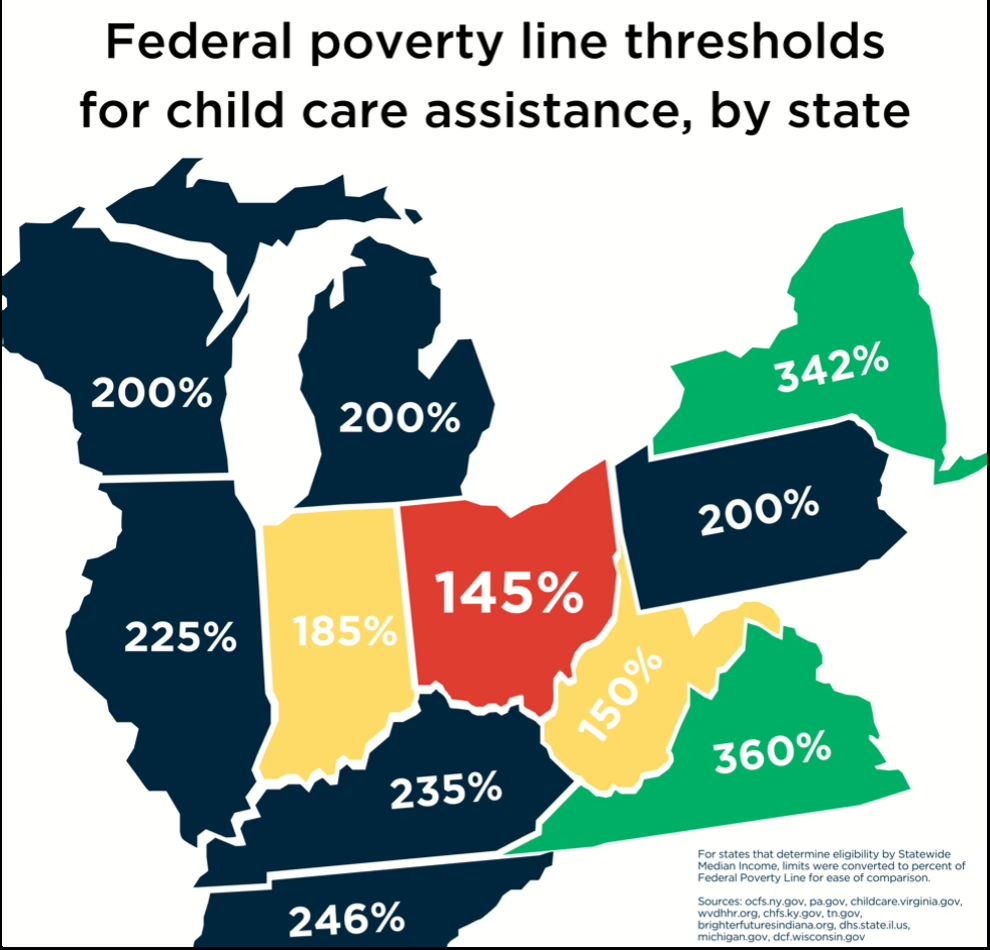
In comparison, New Mexico provides publicly funded childcare to families at 400% FPL, Utah at 300%,[79] Alaska at 225%,[80] and Louisiana at 233%.[81] Even Ohio’s immediate neighbors do better for their families: Michigan, Kentucky, and Pennsylvania provide publicly funded childcare at or above 200% FPL (or an annual income for a family of three of $53,300). In Ohio, someone can remain in the program up to 300% of the FPL once in the program, but having such a low eligibility threshold to begin accessing the program cuts many Ohioans out.
Lawmakers should consider eliminating copayments for those under 150% of the FPL. This would give additional relief to families, alongside the federal mandate to formally cap copays at 7% of a family’s monthly income.[82]
Make childcare free for childcare workers.
Ohio should waive income requirements for childcare workers to participate in PFCC. Kentucky created the first program in the nation for free childcare for childcare workers at no additional cost to parents. Kentucky’s free childcare for childcare workers program assists 5,200 children and 2,900 families in fully paying for childcare.[83] It also directly helps keep 2,900 early childhood educators in the workforce. Each one of those educators keeps 5-15 spots open for other Kentucky children to receive care.[84] That’s 14,500 to 43,500 childcare spots in a state less than half the population of Ohio!
Provide adequate revenue for programs.
Ohio must improve wages and benefits for childcare workers. The state must improve its reimbursement rates[85] up to the federally suggested 75th percentile,[86] consistent with other states and federal guidelines and considered the “benchmark for equal access.”[87] The Office of Child Care in the Department of Health and Human Services justifies this standard, stating that Lead Agencies like DCY are encouraged to “set payment rates high enough so that childcare providers can retain a skilled workforce and deliver higher-quality care to children receiving subsidies.”[88] These higher reimbursement rates need to be tied to a requirement that centers increase workers’ pay.
The state should also guarantee funding to reimburse providers the same way many private pay families do, based on enrollment rather than attendance, to increase stability in the sector. The federal government is already requiring this change—now lawmakers must follow through.[89]
Provide livable wages for childcare workers.
We cannot have quality childcare without funding the people who do the work. Workers deserve their own set of protections. Lawmakers should consider implementing a Care Workers or Domestic Workers Bill of Rights, based on the framework by the National Domestic Workers Alliance.[90] This includes important protections like safe working conditions, rest breaks, overtime pay, and wage requirements. Guidelines for early childhood educators specifically could also include child to staff ratios, health and safety standards (like lead testing), and standardized pay requirements based on experience or education.
The federal government recently released sample contracts for domestic workers[91] that the state of Ohio should consider proving as a resource to people who become licensed by the state or to all publicly funded childcare centers.
Conclusion
As Secretary of the Treasury Janet Yellen said in her 2021 analysis of the childcare system:
Childcare is a textbook example of a broken market, and one reason is that when you pay for it, the price does not account for all the positive things it confers on our society. An enormous body of economic literature finds that kids with access to quality childcare end up in school longer and in higher-paying jobs afterward. When we underinvest in childcare, we forego that; we give up a happier, healthier, more prosperous labor force in the future.
Ohio lawmakers have created a false reality through corruption, gerrymandering, and shifting our tax system to benefit the rich that has formed the idea that advocates have to choose between what’s best for kids, workers, and families. This artificial scarcity is the direct consequence of handouts to the wealthy through a generation of cuts to the income tax. Ohio has the resources to build our infrastructure and it’s time to intentionally distribute them to kids and families. Ohio must provide a decent baseline for everyone, and many of the policies proposed in this brief are a good start.
The authors are grateful to Tami Lunan and the leaders of the Care Economy Organizing Project who provided feedback on this report, PRE4CLE for help accessing crucial data, and the Dignity For All coalition.
Appendix: Key concepts
Publicly Funded Child Care (PFCC): a state program administered by Ohio Department of Job and Family Services that uses state and federal funding to subsidize childcare for families who are income eligible.
Federal Poverty Level (FPL): Federal poverty levels are used to determine who is eligible to participate in public programs like SNAP and Medicaid. They vary depending on how many people are in a household. They are set each year by the federal Department of Health and Human Services.
Types of providers
Childcare centers provide care for more than seven children in a facility that is not a private home. They have at least one employee and are licensed by the Ohio Department of Jobs and Family Services (ODJFS).
In-home care providers are either Type A or Type B. For both types, children under 6 who are family members of providers must be included in count size.
- Type A providers care for up to 12 children at one time and must maintain a ratio of at least one staff member for every six children, with each staff member caring for no more than three children under age 2.
- Type B providers care for up to six children with no more than three under age 2. Type B providers do not have employees.
In-Home Aides are home care providers who can serve multiple families and must be certified for each home every two years.
Day camps care for school-age children during school breaks including summer.
Ohio Department of Education providers funded by PFCC include licensed preschools and licensed school-age care:
- An ODE Licensed Preschool is operated by a public, private, or charter school, or a county board of developmental disabilities.
- An ODE Licensed School Age Child Care Program provides before and after school care at a public, private or charter school.
Reimbursement rates: the amount providers receive from the state for each child in publicly funded childcare. It is calculated based on age of the child, county location, and quality level of the center. The exact amount of the payment is set by comparing the prices charged for similar care by similar centers in the county. Ohio currently reimburses at the 50th percentile: 50% of similar providers in the county charge less, and 50% charge more.
[1] Early Learning Nation’s survey report from September 19, 2023, titled “A Top Priority for Generation Z? Child Care.”
[2] National Database of Childcare Prices. Based on 2022 data. Accessed January 17, 2025.
[3] “Improving Child Care Access, Affordability, and Stability in the Child Care and Development Fund,” ACF Office of Child Care. March 1, 2024.
[4] See “How Ohio’s Publicly Funded Child Care measures up,” Heather Smith. Policy Matters Ohio, March 10, 2025.
[5] See the Annie E. Casey Foundation’s Kids Count Data Center.
[6] Bureau of Labor Statistics Occupational Employment and Wage Statistics. Accessed January 31, 2025.
[7] Bureau of Labor Statistics Occupational Employment and Wage Statistics, accessed January 15, 2025.
[8] From Policy Matters Ohio’s August 27, 2024 report, “State of Working Ohio 2024.”
[9] US Census Data, accessed Jan 15, 2025.
[10] Market Survey Reports are available from Ohio Job and Family Services.
[11] See Center for American Progress’ “Do you live in a child care desert?” Accessed January 27, 2025.
[12] Poll Data from 2024, Groundwork Ohio. Accessed February 10, 2025.
[13] Read Secretary Yellen’s full remarks on “Shortages in the Child Care System” from September 15, 2021.
[14] Federal poverty levels are used to determine who is eligible to participate in public programs like SNAP and Medicaid. They vary depending on how many people are in a household. They are set each year by the federal Department of Health and Human Services, where you can find more information.
[15] See ODCY’s 2024 Update to Child Care Income Eligibility Standards.
[16] According to data from a public records request to the Ohio Department of Children and Youth on PFCC utilization by FPL for calendar year 2024. Received March 13, 2025.
[17] See Rule 5101:2-16-05 Copayment for publicly funded child care benefits. Effective December 11, 2022.
[18] As outlined by Job and Family Services in their overview for providers.
[19] Improving Child Care Access, Affordability, and Stability in the Child Care and Development Fund,” ACF Office of Child Care. March 1, 2024.
[20] A typical household’s income is the “median household income.” It’s in the middle: Half of Ohio households make more, and half make less. According to U.S. Census Bureau’s Quick Facts for Ohio, the median household income in Ohio was $69,680 in 2023. Take 7% of that and you get $4,877.60.
[21] As reported in the Ohio Child Care Resource & Referral Association’s annual report from 2023.
[22] See Scripps Gerontology Center’s report, ”Ohio’s Changing Population.”
[23] The minimum wage in Ohio in 2025 is $10.70 per hour.
[24] The average annual cost of childcare for one infant and one toddler in Ohio is $24,670 at a center in 2023.
[25] See the Copayment Desk Aid from Child Care Manual Procedure Letter No. 182.
[26] See University of Washington Center for Women’s Welfare’s October 2022 report, “The Self-Sufficiency Standard for Ohio 2022.”
[27] For a deeper explanation of how reimbursement rates work, see The Ohio State University: Crane Center for Early Childhood Research and Policy’s “Child care reimbursement rates: a quick explainer.”
[28] See Appendix A to OAC rule 5101:2-16-10 for tables of reimbursement base rates.
[29] OMB Control No: 0970-0114 Lead Agency Implementation Plan for State/Territory Ohio FFY 2025-2027, Administration of Children and Families. See Child Care Manual Transmittal Letter No. 168 for details on the change.
[30] See The Ohio Administrative Code Rule 5101:2-16-10.
[31] See the Center for American Progress’ report from January 29, 2020, “The Child Care Crisis Disproportionately Affects Children With Disabilities.”
[32] See Appendix A to OAC rule 5101:2-16-10 for tables of reimbursement base rates.
[33] “Similar locations” refers to the state’s practice of sorting Ohio’s 88 counties into three categories, each of which has its own set of reimbursement rates. See note 32..
[34] Ranges are provided for infant-, toddler-, and preschool-aged children.
[35] Bureau of Labor Statistics Occupational Employment and Wage Statistics, accessed January 15, 2025.
[36] From Policy Matters Ohio’s August 27, 2024 report, “State of Working Ohio 2024.”
[37] From Ohio’s database of Early Care and Educational programs, accessed January 27, 2025.
[38] See KFF’s State Health Facts Data.
See Council for a Strong America’s report from January 19, 2021, “Early Childhood Programs’ Scarcity Undermines Ohio‘s Rural Communities.”
[40] See Save the Children’s report, “Rural Voters Support Investments to Address Hunger & Provide Quality, Affordable Child Care.”
[41] See Council for a Strong America’s report from January 19, 2021, “Early Childhood Programs‘ Scarcity Undermines Ohio‘s Rural Communities.”
[42] From United States Census Bureau American Community Survey 5-year estimates. Accessed January 27, 2025.
[43] From Ohio’s database of Early Care and Educational programs, accessed March 31, 2025.
[44] See Ohio County Profiles, 2024 Edition. Ohio Department of Development.
[45] According to child care program data from Ohio Department of Job and Family Services’ database of programs, accessed March 31, 2025. For the most up to date numbers and programs in 2025, check out Ohio’s Early Childhood Program Locator Tool.
[46] Racial disparity data are from this Children’s Health Watch report.
[47] “Latine” is a gender-neutral alternative to “Latino” and “Latina.” It affirms that gender is not binary while conforming to conventions of Spanish grammar. Policy Matters consults with stakeholders on preferred terminology and will continue to do so.
[48] The original study uses “other” as an umbrella term for racial groups whose populations are too small to reliably report on discretely. This category aggregates many people of diverse backgrounds, making it difficult to understand this data point except as a generic comparison. Better measurement is needed to understand the unique characteristics and challenges of each.
[49] See the Center for Economic and Policy Research’s June 29,2022 report titled “Lack of Universal Childcare and Other Family Benefits Hurts LGBT Parents and Caregivers.”
[50] According to American Community Survey 2023 5-year estimate PUMS data, accessed January 28, 2025. Out of 42,161 childcare workers in the state, 39,912 are designated as female.
[51] American Community Survey 2023 5-year estimate PUMS data, accessed January 28, 2025. Out of 42,161 childcare workers in the state, 7,853 are designated as “Black alone or in combination with one or more other races.”
[52] US Census Data, Ohio’s 2020 State Profile,
[53] Delesiya Davis took a closer look at this issue in the July 27, 2023 Equal Rights Advocates article, ”Black Women’s Equal Pay Day: Pay Disparities Compounded by Occupational Segregation.” The original research is available in a Center for American Progress report from March 29, 2022 titled ”Occupational Segregation in America.”
[54] From the Center for the Study of Child Care Employment’s December 19, 2019 report, ”Racial Wage Gaps in Early Education Employment.”
[55] See the Economic Policy Institute’s January 15, 2020 report, “Early child care and education in the states.”
[56] As further illustrated by Nina Banks‘ February 19, 2019 report for Economic Policy Institute, ”Black women’s labor market history reveals deep-seated race and gender discrimination.”
[57] See the National Association for the Education of Young Children’s July 2018 report, “The Many Benefits of Continuity of Care for Infants, Toddlers, Families, and Caregiving Staff.”
[58] Some states have different reimbursements depending on age and placement type. See “Child Care and Development Fund Payment Rates,” from the Office of Child Care, an office of the Administration for Children & Families, U.S. Department of Health & Human Services.
[59] Visit Kentucky’s online portal.
[60] See NPR’s October 6, 2023 article, Kentucky had an outside-the-box idea to fix child care worker shortages. It’s working.
[61] See Supporting Child Care Workers as Parents: How the Kentucky Subsidy Income Exclusion for Child Care Employees Helps Increase Access to Child Care, Sarah Vanover, Linda Smith, and Grace Reef.
[62] See Tennessee’s One DHS system.
[63] See Tennessee’s Smart Steps child care program portal.
[64] The Statewide Median Income for a 4-person household in Tennessee in 2024 was $90,197. View the Tennessee Department of Human Services’ “Income Eligibility Limits and Parent Co-Pay Fee Table.”
[65] See the Tennessee DHS statement from October 2, 2023, ”The Tennessee Department of Human Services Increases Reimbursement Rates to Enhance Child Care Access and Support to Families in Need.”
[66] See Maine’s Right from the Start coalition website.
[67] See Maine’s income eligibility criteria (125% SMI), effective October 19, 2024.
[68] Maine Office of the Governor’s statement from July 11, 2023, “Governor Mills Signs Historic Budget Into Law.”
[69] From table B19119 for the five-year estimates of the 2019 ACS through 2023 ACS.
[70] See Maine Center for Economic Policy’s report “Maine’s budget provides historic supports and fortifies the foundation for a strong economy.”
[71] See Maine’s Early Childhood Education and Care Department.
[72] See New Mexico’s Child Care Assistance portal.
[73] 100% FPL for a 4-person family in 2025 is $32,150.
[74] The Albuquerque Journal reported on this election in their coverage from November 8, 2022, “Voters approve amendment to spend more money on early childhood education.” The official election results are available from the New Mexico Secretary of State.
[75] See New Mexico Voices for Children’s report from November 9, 2022, “New Mexico is the First State to Guarantee a Right to Early Childhood Education.”
[76] See New Mexico Early Childhood Education & Care Development’s February 16, 2024 press release “New Mexico continues to lead the nation in early childhood investment.”
[77] The Santa Fe New Mexican reported on this legislation in their coverage from July 20, 2023 titled “State finalizes new child care assistance rules.” The full text of the rule can be found in Volume XXIV, Issue 13 of the New Mexico Register from July 18, 2023.
[78] See the HHS Federal Poverty Guidelines for 2025. Currently, families can remain eligible for PFCC until their income reaches 300% of the FPL, but only if they previously qualified when their income was below 145%.
[79] Child Care Income Eligibility and Co-Payment, Utah Department of Workforce Services. Effective October 1, 2024.
[80] See Family Income and Contribution Schedule, Alaska Department of Health. Revised February 21, 2022.
[81] See Child Care Assistance Program, Louisiana Department of Education. Accessed February 3, 2025.
[82] See the Federal Register text of the rule, ”Improving Child Care Access, Affordability, and Stability in the Child Care and Development Fund.”
[83] See “Supporting Child Care Workers as Parents: How the Kentucky Subsidy Income Exclusion for Child Care Employees Helps Increase Access to Child Care,” Sarah Vanover, Linda Smith, Grace Reef. Buffett Early Childhood Institute. 2024.
[84] See 922 KAR 2:120 Child-care center health and safety standards.
[85] For a deeper explanation of how reimbursement rates work, see The Ohio State University: Crane Center for Early Childhood Research and Policy’s “Child care reimbursement rates: a quick explainer.”
[86] See the Federal Register text of the rule, ”Improving Child Care Access, Affordability, and Stability in the Child Care and Development Fund.”
[87] For a deeper discussion of Ohio’s reimbursement rate, see Policy Matters Ohio’s report, “New rule for child care could lower costs for families and stabilize providers,” from August 24, 2023.
See: “Understanding the 75th percentile,” ACF Office of Child Care. Last Reviewed January 21, 2025.
[88] See the Federal Register text of the proposed rule, ”Improving Child Care Access, Affordability, and Stability in the Child Care and Development Fund.”
[89] See the Federal Register text of the rule, ”Improving Child Care Access, Affordability, and Stability in the Child Care and Development Fund.”
[90] Learn more about NDWA’s Domestic Worker Bill of Rights.
[91] See the US Department of Labor, Women’s Bureau for sample employment agreements for domestic workers.