
Voucher programs siphon funds, weaken public schools
UPDATE (3/4/25): The original version of this release used out-of-date information about the change in private-school enrollment compared to voucher uptake. The state now reports that enrollment grew by 3,700 students. This means that some 65,000 vouchers went to those private school families.
Ohio’s voucher programs use public funds to subsidize tuition at eligible private K-12 schools. Ohio has three general education voucher programs – EdChoice, EdChoice Expansion, and the Cleveland program – that together provide a publicly funded voucher for any Ohio family, regardless of income.
Learn how vouchers harm public schools in your state House and Senate districts.
Not sure which districts are yours? Use this tool.
The state spent a combined $731 million for the 2023-24 school year on these three programs, up from $400 million the previous year.[1] Two other programs provide publicly funded vouchers for students with special needs; together they cost the state $237 million for the 2023-24 school year. The governor’s budget for the coming biennium proposes to spend more than $1.25 billion to fund all five programs for the 2026-27 school year, while reducing funding for traditional public schools.[2]
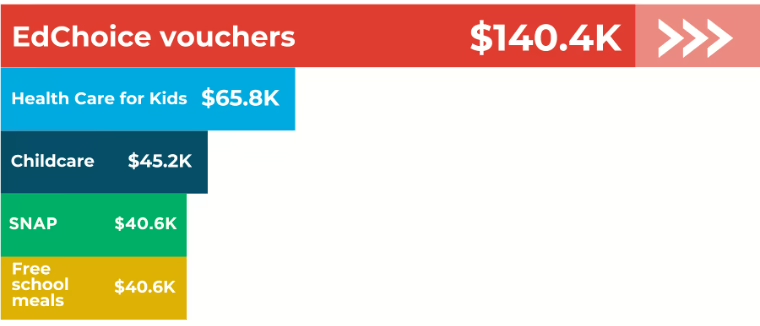
Ohio lawmakers drove this increase in the last state budget by making vouchers universally available to all Ohioans except Cleveland residents through EdChoice Expansion. This destructive push to privatize education harms public schools and the 90% of students and families in our state who rely on them. Households with incomes up to 450% of poverty – a family of four with a $140,400 annual income – qualify for the full value of $6,166 for K-8 and $8,408 for high school. Above 450%, the public subsidy gradually drops, with even the richest Ohioans still receiving 10% of the full voucher.[3]
Ohio lawmakers say the state can’t afford to assist more families with essentials like food assistance (the Supplemental Nutrition Assistance Program, or SNAP, and school lunches), childcare, and healthcare for kids. Yet, as Figure 1 shows, they have chosen to prioritize private school tuition assistance with no income cutoff.
Figure 1
Legislators strictly limit assistance for basic needs, issue vouchers at all income levels
Annual income cap for a family of 4 to access public services
Because of the radical change legislators made in the last state budget, thousands of households already sending kids to private school without help from the state received these vouchers. In the 2023-24 school year, Ohio gave out nearly 69,000 new EdChoice Expansion vouchers, but private school enrollment grew by just 3,700 students.[4] This means that some 65,000 vouchers went to those private school families.
That same year, participants in the EdChoice Expansion program became wealthier and whiter: only 17% of users in 2023-24 qualified as low-income compared to 67% the previous year.[5] The number of white participants in the Expansion program more than quadrupled in the 2023-24 school year.[6]
The percentages of new and renewing voucher recipients and those qualifying as low-income stayed relatively stable from year to year for the original EdChoice program and the Cleveland voucher.[7]
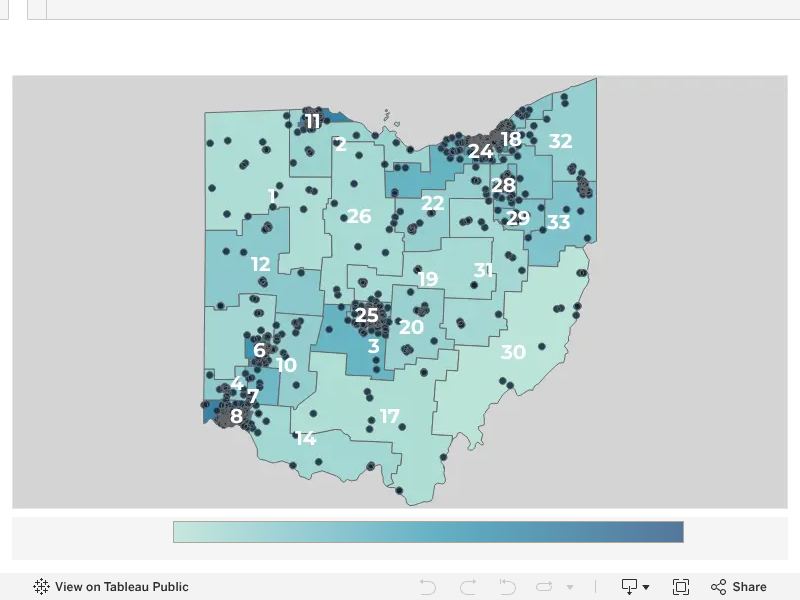
Private schools are concentrated in or near urban areas, siphoning funds away from public schools – especially those in rural areas where few, if any, nonpublic schools exist – and into the budgets and endowments of private schools.
Figure 2
Voucher schools are concentrated in or near Ohio’s urban centers.
(Use the tabs at the top left of the graphic to switch between Senate and House district maps.)
Allowing vouchers to extract more public dollars from the state budget increases school district dependence on local tax levies. This means everyday Ohioans have to make up the difference or live with increasingly underfunded public schools.
Vouchers threaten communities’ biggest asset: a local civic hub and a great education for all children, no matter where they live or how much money their parents have in the bank. That impacts all of us, whether we have kids in school or not.
Private voucher schools…
Can legally reject certain students, including those with disabilities, behavior issues, poor academic performance, or education challenges. Parents enrolling their children in private schools, especially children with disabilities, give up their rights to a free and appropriate public education.
Can price-out Ohio families. Many private schools charge more than the voucher, raising barriers for many of the families voucher advocates claim they want to help.
Are not held accountable and operate without transparency. They do not have to meet state standards for quality, financial management, or student rights.
Often include religious education as a foundational mission.
Certain Ohio legislators, from the top down, seem intent on expanding support for private education. They could do this by lifting caps on voucher amounts for people with higher incomes, expanding the types of schools that can accept vouchers, increasing the homeschool tax credit, or even removing the ability of local school districts to raise funds with local levies and bond issues and creating a new system that funds schools, public and private, on a per-pupil basis that would disregard the differing needs of students who come from different backgrounds or live in different parts of the state.
Ohioans from all walks of life, from big cities and suburbs to villages and townships, have to work together to support public education for everyone. We can do this by contacting our state representatives and state senators to make sure the two-year budget under negotiation at the Statehouse right now fully funds the public schools that educate the majority of Ohio’s kids and doesn’t enable any further expansion of vouchers. Already, Gov. Mike DeWine’s proposal would increase public dollars spent on vouchers while cutting funding for traditional district schools. We must mobilize to stop this attack on public education to make sure everyone has the opportunity to learn.
[1] Ohio Department of Education and Workforce (DEW), Nonpublic Data Portal, Scholarship Payments, retrieved March 2025.
[2] Ohio Legislative Service Commission spreadsheet, “HB96-136_IN CompSummary 2.11.25.”
[3] DEW, EdChoice Expansion Income Eligibility Requirements for 2024-2025.
[4] DEW, Enrollment Data, retrieved March 2024.
[5] DEW, Nonpublic Data Portal, Scholarship Paid Participants, retrieved February 2025.
[6] Same as above.
[7] Same as above.