
Funding threats and sweeping layoffs jeopardize LIHEAP
The Trump administration has destabilized the social service landscape with reckless, unvetted layoffs and proposed spending cuts. Communities who rely on federal assistance programs to support their families and build financial security will bear the costs. Mass layoffs in the U.S. Department of Health & Human Services (DHHS), announced April 1, 2025, jeopardize 10,000 jobs in the federal government, including the entire staff responsible for administering the Low Income Home Energy Assistance Program (LIHEAP).[1]
Though the Division of Energy Assistance represents a small share of DHHS staff – only ten employees – it plays a key role in implementing a critical program that serves as a lifeline for households with undue energy burdens (the percentage of household income spent on home energy costs).
LIHEAP is a federally funded program that offers utility bill assistance to income-eligible populations, enabling Ohio families to maintain a healthy temperature in their homes, keep the lights on, and keep food fresh. Federal LIHEAP administrators are responsible for allocating LIHEAP block grant amounts to state agencies, who are then responsible for designing and implementing a state energy assistance program, known in Ohio as the Home Energy Assistance Program (HEAP).[2] DHHS funded Ohio’s HEAP with an average of $292.9 million per year between FYs 2019 and 2023.[3]
A document recently obtained by several media outlets revealed the Trump administration’s intention to eliminate LIHEAP entirely, ending HEAP in Ohio and similar programs in other states.[4] Through a process known as a “passback,”[5] the White House Office of Management and Budget (OMB) instructed DHHS to develop a reorganization plan “consistent” with its draft budget proposal, which zeroes out federal LIHEAP appropriations for FY26. Even if Congress were to restore LIHEAP funding in the federal budget, the vacant Division of Energy Assistance leaves no one to review state LIHEAP plans or allocate funds in FY26.
More than 265,000 Ohio households received energy assistance in 2023
In Ohio, households with high energy burdens can apply for HEAP benefits paid directly to their utility company, providing a buffer between Ohio families and utility disconnections during times of financial instability.
HEAP served 265,455 households in 2023, just 20.5% of the eligible population. Among the Ohio households that received energy assistance services in 2023:
- 46.5% included a person with a disability.
- 39.5% included someone 60 years or older.
- 13.9% included a child 5 years or younger.
Energy assistance can be lifesaving for older Ohioans, families with young children, and Ohioans with a disability, who disproportionately face high energy burdens. Older populations and children under two are acutely vulnerable to unsafe indoor heating, which accounts for an estimated 45% of heat-related deaths in the U.S. over the past 20 years.[6] During colder months, households may live in uncomfortable, unsafe conditions or use secondary heating equipment – like stoves, ovens, or space heaters – to lower their energy use, increasing exposure to toxic indoor air pollutants.[7] High energy burdens also have serious implications for Ohioans with a disability, who often rely on electric-powered medical devices to maintain their quality of life.[8]
Among the broader population, energy affordability issues correspond with greater risks for respiratory illnesses, exacerbate chronic stress and mental health conditions, and further entrench household economic insecurity. For home energy costs to be affordable for Ohio families, households should spend no more than 6% of their annual income on utility bills.[9] In 2023, however, HEAP recipients spent an average of 22.4% of their annual household income on home energy costs before receiving benefits, the second-highest rate in the U.S.[10]
The same year, HEAP benefits restored home energy services for 6,831 households and maintained services for 83,271 households experiencing bill-payment issues. Most households who lost or were at risk of losing services faced a shutoff or received a disconnection notice from their gas or electric utility provider. Electric utilities account for most service restoration occurrences following a utility shutoff (74.2%) and disconnection notices received by HEAP participants (74.1%), while gas utilities make up the remainder.
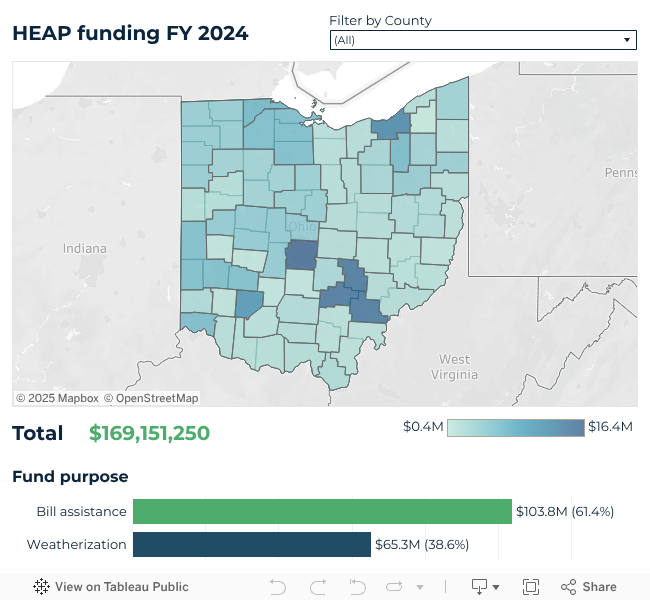
The map below shows the distribution of sub-grants delivered by the Ohio Department of Development to local HEAP providers.[11]
HEAP funding distribution, FY 2024
Energy assistance is a lifeline for Ohio families struggling to keep up with rising utility costs
The decision to terminate the entire LIHEAP staff comes as nearly $400 million in unallocated funds has yet to be disbursed to state grantees,[12] despite uncertainty in U.S. energy markets generated by the Trump administration’s erratic tariff announcements and threats to the Inflation Reduction Act’s clean energy tax credits.[13] Moreover, residential electricity rates are expected to increase by 10 to 15% beginning in the summer of 2025 due to the recent capacity auction held by PJM Interconnection, the organization that manages and operates Ohio’s electric grid.[14]
Without even considering current funding threats and rising energy costs, federal LIHEAP appropriations haven’t kept pace with existing need. The share of households underserved by HEAP has increased from 66.7% in FY14 to 79.5% in FY23. More recently, approximately 25.4% of Ohio adults reported living in a household that was unable to pay an energy bill in full at least once in the 12 months prior to September 2024, compared to 23.2% of U.S. adults. The figure below compares the share of U.S. and Ohio adults in households unable to pay an energy bill over the last year of the Household Pulse Survey.[15]
Unpredictable weather patterns and unprecedented heatwaves — squarely linked to the climate impacts of private utilities’ extractive practices — exacerbate energy insecurity among Ohio households. Despite multiple repeal attempts,[16] Ohio ratepayers are still paying for H.B. 6’s coal subsidies, implicated in one of the largest utility scandals in U.S. history.[17] Ohio lawmakers have also enabled utilities to raise costs for customers without sufficient oversight or accountability, while undermining policies that would support renewable deployment and energy efficiency programs to lower residential energy costs.
With a destabilized economy and rising energy costs, public policy should reinforce families’ economic security and create pathways out of poverty. The administration’s unconscionable efforts to erode the public service landscape do the opposite. LIHEAP may not be the solution to decades of state policy decisions that favor the private interests of Ohio’s monopoly utilities at everyday ratepayers’ expense. However, in the absence of comprehensive utility reform, LIHEAP offers a lifeline to families who are one late payment away from a shutoff.
[1] “Entire staff responsible for utility assistance included in HHS cuts,” J.J. McCorvey, NBC News, April 1, 2025.
[2] Home Energy Assistance Program (HEAP), Ohio Department of Development.
[3] Total program funding data, FYs 2019-2023, available at the LIHEAP Performance Management’s data warehouse. Data for FYs 2022 and 2023 are preliminary and subject to final data validation.
[4] “Trump administration eyes elimination of program that helps low-income people heat and cool their homes,” by Rachel Frazin, The Hill, April 18, 2025.
[5] The Role of the Office of Management and Budget in Budget Development: Congressional Research Service, 2024.
[6] “Nearly half of heat-related deaths happen at home,” by Anna Kutz, The Hill, June 25, 2024.
[7] “How High are Household Energy Burdens?” by Arel Drehobl, Lauren Ross, and Roxana Ayala, American Council for an Energy-Efficient Economy, 2020.
[8] “The electricity cost burden of durable medical equipment in the United States,” by Carley, S., Bansal, S., Harak, C. et al. Scientific Reports 14, Article 31152. 2024.
[9] Extant research maintains a 6% threshold to identify “high” energy burdens, while an energy burden greater than 10% is considered “severe.”
[10] Preliminary 2023 data, available at the LIHEAP Performance Management’s data warehouse.
[11] HEAP sub-grant amounts are drawn from the Ohio Department of Development Grants & Loans dataset, aggregated to local HEAP providers’ service area. Note: Though local HEAP providers have an intake site in each County, County-level grant data were not available for those served by one provider if the provider’s main office were based in a different County. For example, Bridges Community Action Partnership serves Champaign, Delaware, Logan, Madison, and Shelby Counties, and funding data were only available for Union County. Each County is served by one HEAP provider, with the exception of Cuyahoga and Franklin Counties, with two providers each.
[12] “HHS fires entire staff of program that helps low-income people afford heat and air conditioning,” by Rachel Frazin, The Hill, April 2, 2025.
[13] “Trump’s tariffs undermine his energy and manufacturing goals,” by Jeff St. John, Canary Media, April 7, 2025.
[14] “Why Ohio’s Electric Rates are Rising: The PJM Capacity Auction Explained,” NOPEC, January 2025.
[15] Summary of Household Pulse Survey data: adults in households that were unable to pay an energy bill in full in the last 12 months, Phases 4.1-4.2.
[16] Two pieces of state legislation pending in the House and Senate would repeal H.B. 6 coal subsidies. Ohio House lawmakers recently voted to pass H.B. 15, a comprehensive bill designed to address energy supply issues, including a “community energy” provision that would support the development of shared renewable projects to lower residential energy costs, with additional provisions to repeal H.B. 6 coal subsidies.
[17] “In Ohio, another attempt to repeal HB 6 coal subsidies,” by Kathiann M. Kowalski, Canary Media, February 28, 2025.