
Ohio’s legislature has repeatedly reduced the state share of funding for public K-12 education, forcing our kids, teachers, and school communities to do more with less — even as the state spends billions on private tuition vouchers.

Ohio schools depend on the real property tax. Some 247 of the state’s 606 districts rely on the tax for at least 40% of their operating expenses. This is a key reason why the proposed property tax repeal, with no replacement revenue, is misguided and destructive. The interactive map below uses the most recent available data to show the crucial role property taxes played in school operation expenditures last year. It’s part of a brief, which you can read here. All the data in the map is also available in this searchable, sortable table.
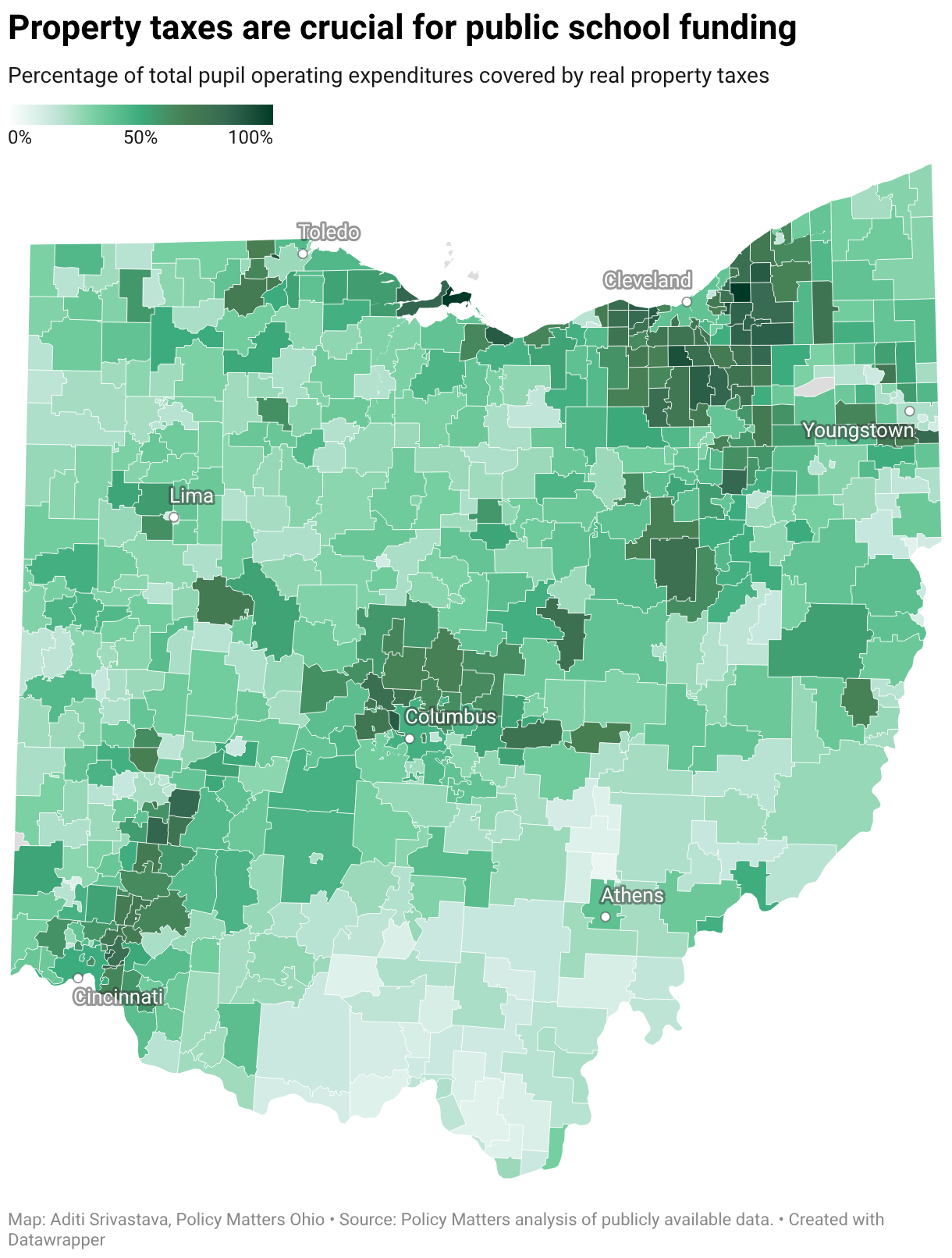
The district with the highest share of total pupil operational funds generated by the property tax is Danbury Local, which covers the Marblehead area. With its vacation homes, it has relatively high property values compared with other districts; recent reappraisals drove them even higher. The second-highest, Mayfield City Schools ranks second. Voters there approved a new levy in November 2024 that likely contributed to its ranking.
Ohio’s legislature has repeatedly reduced the state share of public school funding, from a high of 47% in 1999 down to an estimated 35% in 2026 and 32.2% for 2027.[1] This reduction in state share means that property tax revenue accounts for an increasingly large portion of Ohio public school funding.
As property taxes rise, some Ohio homeowners are struggling to pay the new amounts. The best solution for keeping property taxes more affordable and fully funding public schools is a property tax circuit breaker, which would offer targeted relief to the Ohioans whose property taxes are too high a share of their income. Instead of such targeted relief, Ohio passed four property tax reform bills at the end of 2025 (H.B. 129, H.B. 186, H.B. 309, and H.B. 335) that further reduce school funding by limiting revenue from property taxes.
These anticipated losses to schools total:
In a small win for Ohioans, the legislature amended H.B. 186, adding $360 million in FY 2027 and $105 million in FY 2028 from the General Revenue Fund to offset some of the losses to schools.
[1] Howard Fleeter, “OEPI Initial Analysis of Executive Budget K-12 Funding Proposal,” Ohio Education Policy Institute, February 2025.
[2] Tax Year 2025 ran January 2025 through December 2025, whereas State Fiscal Year (FY) 2025 ran July 1, 2024 through June 30, 2025.